

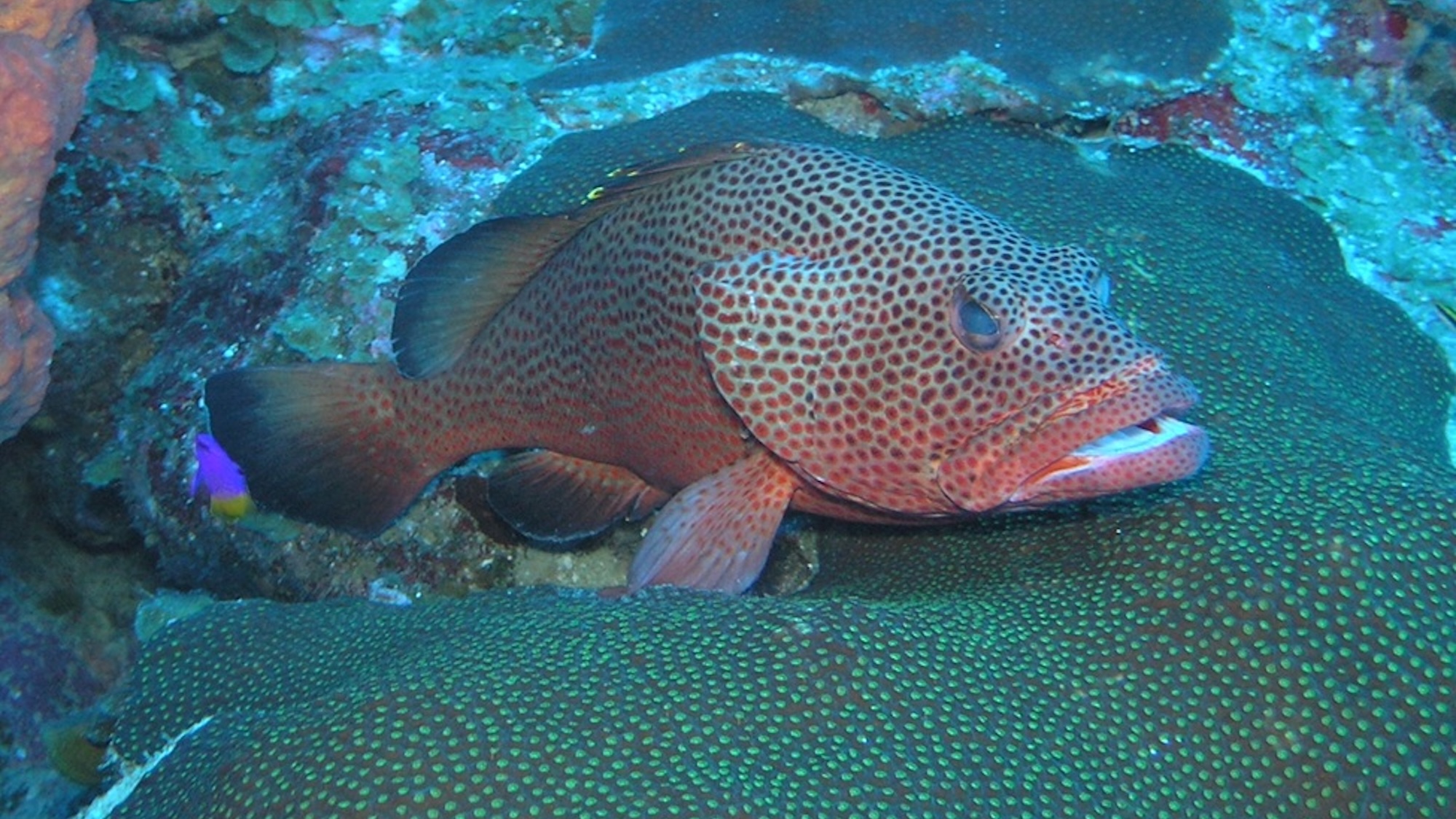
The red hind grouper (Epinephelus guttatus) is big on grunting. But the rhythmic, low-frequency intonations aren’t just random underwater chatter. After analyzing over 2,000 hours of ocean acoustic recordings gathered over 12 years, marine biologists say that groupers convey specific messages to one another about courtship and territory with their grunts. And with the help of an advanced machine-learning tool, researchers now believe the observational approach detailed in a study published in the ICES Journal of Marine Science can help other scientists to better monitor fish populations, as well as improve ongoing conservation efforts for threatened species.
Red hind groupers are one of around 500 known hermaphroditic fish species. More specifically, they are protogynous hermaphrodites, meaning they begin life as biological females, before later transitioning to become males. During the winter, thousands of Caribbean red hinds swim over 18.5 miles from their usual coral reef habitats to spawn (and grunt) under the light of the full moon.
In 2007, a research team led by Florida Atlantic University’s Harbor Branch Oceanographic Institute dropped a passive acoustic monitoring system into a known red hind spawning area off the west coast of Puerto Rico. They then continually documented the site for over a decade, amassing thousands of hours of audio while never directly disturbing the local fish population.
Instead of focusing on ambient sound levels, the marine biologists on this team were primarily interested in distinguishing mating calls. To do this, they used a machine-learning program called the Fish Acoustic Detection Algorithm Research (FADAR) system. Using FADAR, they were able to quickly analyze their gigantic dataset in a fraction of the time it might have taken on their own.
“Thanks to FADAR, we processed 12 years of acoustic data in weeks—uncovering patterns that would have taken years to find,” study co-author Laurent Chérubin said in a statement. “It’s a game changer for monitoring and managing reef fish like red hind.”
Chérubin and colleagues discovered that male red hinds generally offer their neighbors one of two grunts. One grunt is for courtship and the other is to defend their territory. Beyond differentiating between the sounds, the team also confirmed consistent seasonal patterns in the grouper’s spawning activity that are closely linked to lunar cycles.
What’s more, the study’s timespan offered insights into the fishes’ shifting population patterns. Between 2011 and 2017, red hinds more often issued courtship grunts. But beginning in 2018, the sounds shifted more towards competitive and territorial warnings. By the study’s conclusion, these aggressive grunts had nearly tripled from the outset.
“This shift could indicate changes in the population, such as an increase in the number of older or more dominant males, changes in sex ratios, or even a shift in the core spawning area,” explained Chérubin.
The team’s passive monitoring system may soon go beyond grunt hunting. Researchers believe their approach could help resource managers working on marine conservation efforts and sustainable fishing practices, by listening to what the animals are doing, without disturbing them.
“This study shows how much we can learn simply by listening,” Chérubin said. “It’s transforming our understanding of the ocean.”

More deals, reviews, and buying guides
