


There’s a saying in corn country: “Knee high by the Fourth of July.” The adage refers to a farmer’s goal for their crops if they hope to make the October harvest. And while most Midwesterners are familiar with the axiom, Tim Fitzgerald knows the folksy refrain lost its relevancy decades ago.
“That hasn’t actually been true since prior to modern fertilizers. Nowadays corn is about six feet or taller by the Fourth of July,” Fitzgerald, a farmer in Lafayette, Indiana, tells Popular Science.
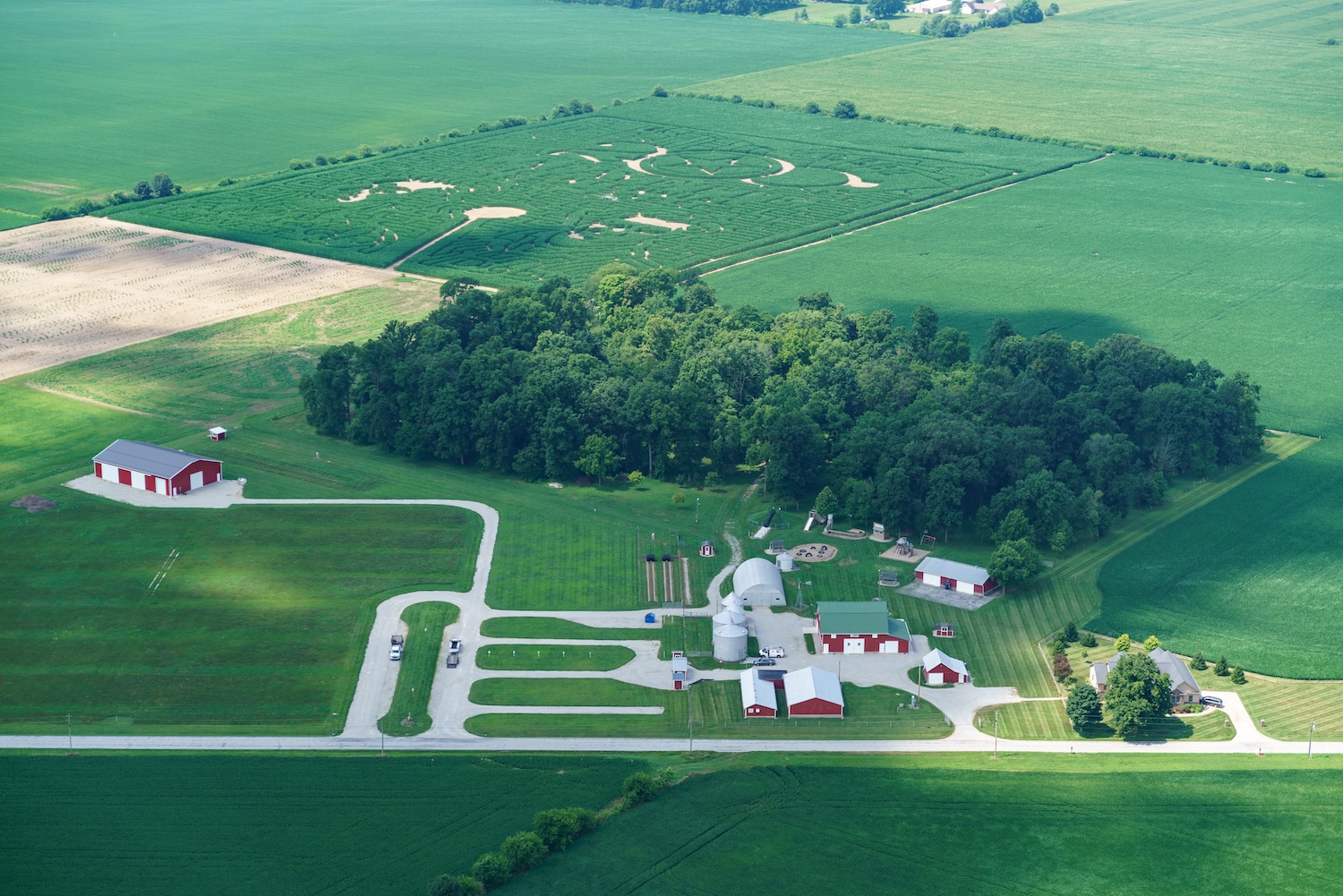
Fitzgerald, however, still adheres to the classic timeline. That’s because his farm is no longer strictly in the agricultural business. After a 22-year career in industrial trade show designing, Fitzgerald has since spent nearly that long overseeing “northwest Indiana’s largest corn maze,” Exploration Acres.
Commercial farmers often finish planting by mid-May, but Fitzgerald’s team starts sowing the first week of June. By the time Fourth of July fireworks are shimmering overhead, Exploration Acres’ corn is inching towards your waist. The strategy isn’t out of a reverence for tradition, however.
“We plant later because we want to have corn that’s as green as possible for as long as possible. We also use really late-maturing corn that matures at around 113 days,” he explains.
Once Fitzgerald opens the maze in September, its winding walls are well above the heads of the estimated 45,000 seasonal visitors that trek its miles of pathways. But ensuring the proper height is only one component of the monthslong mazebuilding endeavor—a process that’s equal parts logistics, agricultural science, technological coordination, and artistry.
The olden days
Fitzgerald was already well-suited for the labyrinth business when he transitioned careers and converted his family’s dilapidated farm into a regional attraction in 2008. During his time away, however, much of the nearly century-old property had started to crumble.
“It was literally falling apart,” he remembers.
As the agricultural industry continued its shift away from smaller farms to corporate megafacilities, places like Exploration Acres transitioned into the agritourism business. These repurposed farms offered schools seasonal educational opportunities, as well as the chance to turn fields into symbolic celebrations of America’s favorite cash crop.
Ahead of fall 2008, Fitzgerald reached out to Shawn Stolworthy at MazePlay, an Idaho-based company specializing in all things corn maze, to plan out his first labyrinth. The maze designs at Exploration Acres today range anywhere from 18 to 23 acres depending on the season, but Fitzgerald settled on a comparatively modest 15-acre arrangement for the inaugural year.
Just as farming has modernized over time, so has the process that goes into preparing a corn maze. As Fitzgerald explains, the early strategy relied on a subtractive approach. Step one was to plant and grow your corn at the appropriate time. Meanwhile, Fitzgerald decided and created an artistic theme himself. Once the pathways were finalized, it was a matter of creating the maze’s vector files in Adobe Illustrator. No, really.
“MazePlay developed proprietary software that lets you cut mazes using GPS. At that time, it was all vector-based,” he says. “You were basically creating a center line where the paths would be, and then you used steer-track technology on tractors that allowed the tractors to autonomously follow the vectors. You set your ground speed, and it goes.”
During that era, a tractor’s turning radius and other factors limited the maze’s complexity. In an ideal world, Fitzgerald would have simply planted corn only where needed and left the rest barren for visitors to walk. It took nearly a decade for the technology to catch up with that idea. Enter: SpeedTubes.
‘Printing’ pathways
SpeedTubes are designed so farmers can customize the spacing between crops as a way to increase growth while minimizing the risk of disease. But Fitzgerald and his collaborators saw another use for them.
“We wouldn’t need to use as much corn because we wouldn’t need to plant the entire field. We’ll just plant corn where we need it,” he says. “Basically what they do is they have this little vacuum servo on it that will hold onto the little grain of corn until you want to drop it precisely.”
Exploration Acres began experimenting with the new strategy in 2017. The results were immediately noticeable. Instead of ten seed bags, the SpeedTube-assisted design required only seven. (A single bag of seed can plant around two-and-a-quarter acres of corn.)
Gone were the days of tractors plowing through a field to carve out walkways. Now, they simply roll from one side of the acreage to another, turn, and repeat the process. With the design keyed into the onboard software, the speed tubes did the rest by dropping seeds only where necessary.
“Everytime any of those rows intersect with a [maze] path, the speed planter will turn off until it gets to the other side and then it turns back on. There are actually these little LED lights on the back of the hoppers going red-to-blue, red-to-blue,” Fitzgerald says.
He likens the new approach to the moment everyone swapped out their dot-matrix printers for inkjets. Not that the first year wasn’t without complications.
Trial and error
“It’s really pretty simple technology, but what we ran into in 2017 was whenever the tractor made a turn, it reversed direction,” he recalls.
This meant that upon its return runs, everything was off by several feet.
“We had a blurry image,” says Fitzgerald.
Of course, with the seeds planted underground, the workers didn’t immediately realize the issue. It was only after a few weeks when the first baby corn sprouts emerged that they noticed something amiss.
“It created a huge headache,” he remembers.
They ultimately fixed the skewed design by actually planting additional seeds at an offset distance. They then returned with the trusty tiller and removed the extra stalks they didn’t need.
“You’re Popular Science. Part of science is trial and error. You have a hypothesis and you try to prove and disprove. So you learn things,” he says with a laugh.
With a valuable lesson learned, Fitzgerald put the new system to the test the following year and made national news. Remember that Netflix-approved Stranger Things corn maze in 2018? That was Exploration Acres.
“I actually had to sign an NDA, and they shared with me what the season was going to be about, so we originally designed a whole maze for the next season,” he says.
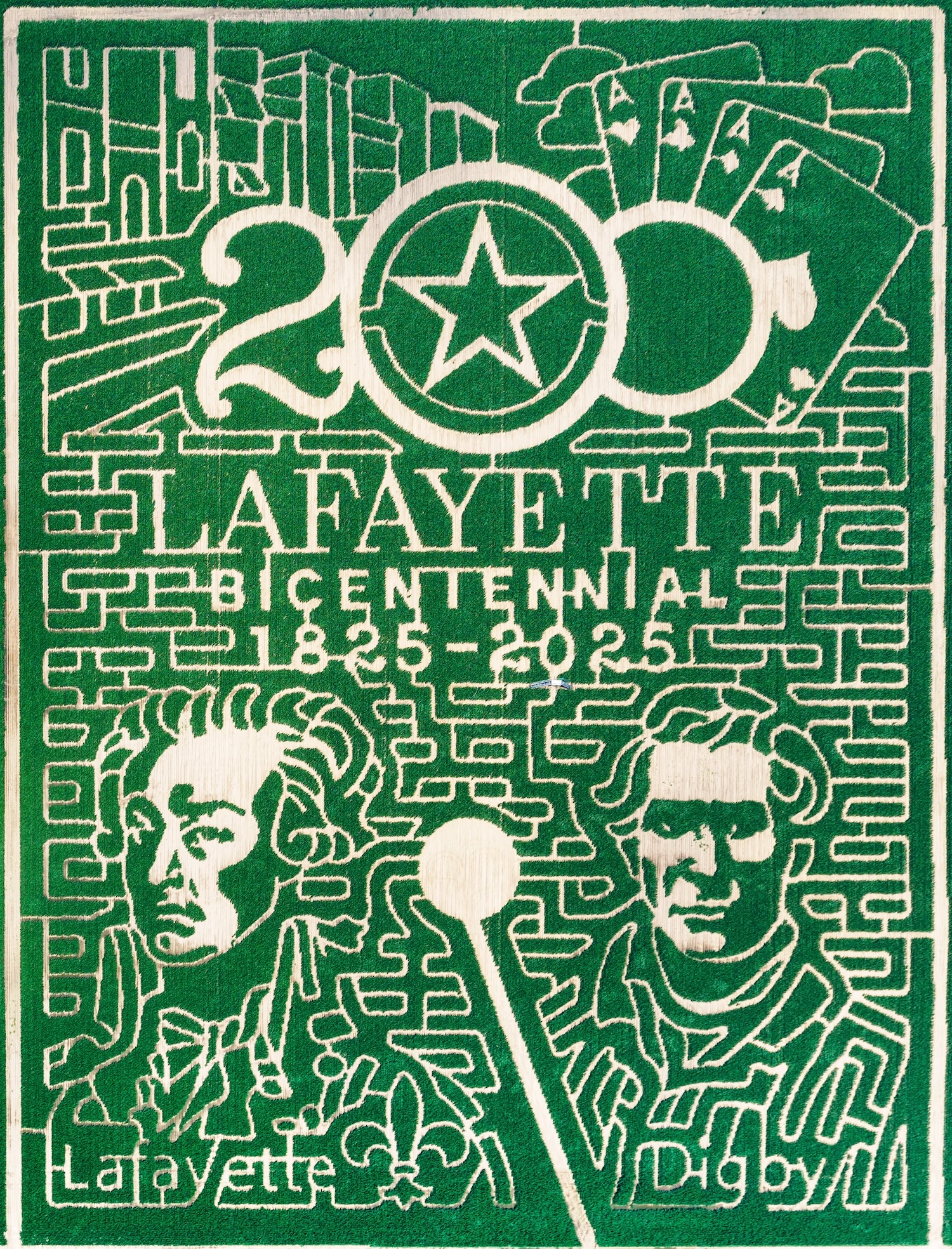
Other mazes have celebrated the Apollo moon landing, dinosaurs, zombies, pirates, and other subjects. This year marks Lafayette’s bicentennial, so Exploration Acres partnered with city officials to design an ode to the town. Visitors this season will wander through portraits of the town’s founder, William Digby, as well as its Revolutionary War namesake, the Marquis de Lafayette. Although 2025’s theme required a bit more outside guidelines, there are some general rules Fitzgerald keeps in mind when sitting down to plan out his next creation.
“I always try to have a good composition—a good use of positive and negative spaces,” he says.
It’s also important to rotate the maze between fields. Fitzgerald’s farm includes four maze locations, always near their annual pumpkin patch. When not used for the orange gourds, the workers also plant soybeans for the free nitrogen they produce and thus minimizing the need for fertilizer.
Mapping a route forward
After nearly two decades in operation, Exploration Acres has the maze process down to a science. But its owner knows there will always be a need to experiment with new approaches. It’s inevitable as the climate crisis continues to make its presence felt. Normally, trees on the farm have already littered the grounds with walnuts, hickory nuts, and acorns, but this year’s extended drought has dried the ground and made it a haven for pests.
“I’ve got rodent pressure,” Fitzgerald says. “I’ve got voles and moles and chipmunks and squirrels. All of them digging up and eating my tulip bulbs. There’s nothing else for them to eat, it’s been so dry.”
Then there’s the heat. The first few weeks of the 2025 season have seen a dramatic drop in attendees due to record-setting temperatures.
“That’s been a major change since we started in 2008,” he explains. “Back then, people would come out and they’d drink hot cocoa. They’d wear mittens and gloves and a winter jacket—it’d be 38 or 40 degrees out and blustery.”
Fitzgerald has even jettisoned the hay bales that normally line their wagon rides. While straw is easy to sit on if you’re wearing long pants, it’s a much itchier experience in shorts.
“The price of straw’s gone up, hardly anyone plants wheat around here anymore. So I just said, ‘To heck with it,’ and put in benches in the wagons. A lot of things have had to change with time,” he says.
There is, however, at least one detail you can count on at Exploration Acres’ gigantic corn mazes. No matter how complicated the trails may seem, there’s no need to get spooked if you find yourself turned around among the pathways.
“We rarely get anyone lost in there. We have an emergency path that lines the perimeter with several exits,” Fitzgerald assures.

Shop Amazon’s Prime Day sale
