


The Roman Empire paved the way for many modern advancements—including streets themselves. At its apex during the second century CE, the vast empire encompassed more than 55 million citizens living between present-day Britain to the west and as far east as Syria. Its vast network of roadways facilitated tax collection, military transport, trade, and everyday travel. But after almost 2,000 years, today’s historians still lack a complete understanding of the empire’s myriad routes. After analyzing a range of topographical maps, satellite images, firsthand records, and archaeological sites, researchers from Denmark’s Aarhus University and the Universitat Autònoma de Barcelona in Spain believe they have digitally recreated the most detailed, accurate map of Rome’s roads circa 150 CE.
A publicly available project, Itiner-e also shows a bit of impressive historical revision is in order. It now appears that Rome included around 186,000 miles of roads. This means we’ve underestimated the total length of the empire’s routes by more than 62,100 miles—almost doubling previous mapping efforts.
“This increase is due to a higher coverage of roads, but also by the decision to make a spatially explicit dataset that adapts routes to the geographical reality (i.e., to cross a mountain, our roads follow a winding pass rather than a direct line),” Itiner-e’s creators wrote in an accompanying study published on November 6 in the journal Scientific Data.
The latest updated maps now indicate Rome’s roads covered over 1.5 million square miles. The exponential increase largely comes from Itiner-e’s creators determining that many more routes crisscrossed the Iberian Peninsula, Greece, and North Africa than scholars previously believed. The database currently includes 14,769 road sections, with nearly 63,400 miles of main routes and about another 121,600 miles of secondary roads.
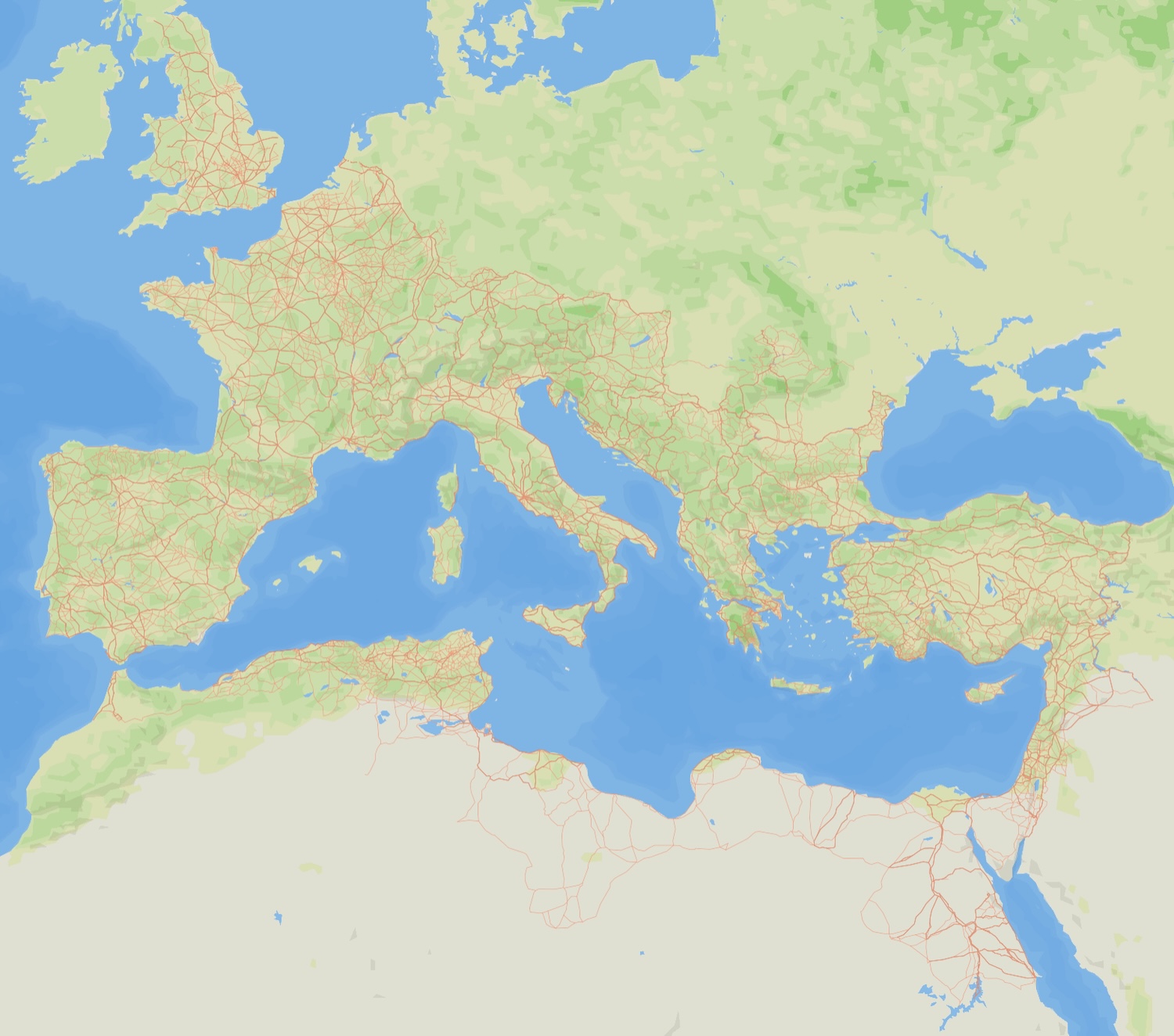
Ancient Roman planners placed stone milemarkers at regular intervals along their streets, but only a handful remain today. Meanwhile, even fewer actual roads remain discernible in the modern landscape. Because of this, Itiner-e’s designers say only 2.7 percent of the map can be known with certainty. Although nearly 90 percent of the remaining map is less precisely established, the study’s authors remain confident about their general location based on primary sources and estimates from topographical information. Only 7.4 percent of Itiner-e’s paths are hypothesized. The researchers also note that the map illustrates a single moment in the Roman Empire’s more than 500 years of existence.
“Itiner-e makes such gaps in our current knowledge of Roman roads explicit for the first time…Detailed temporal evidence for road construction, use, and change is only available for a handful of cases, making an evidence-based reconstruction of how the road system changed…currently impossible,” the authors wrote. “This should be the subject of dedicated large-scale efforts in future research.”

2025 Holiday Gift Guide
