

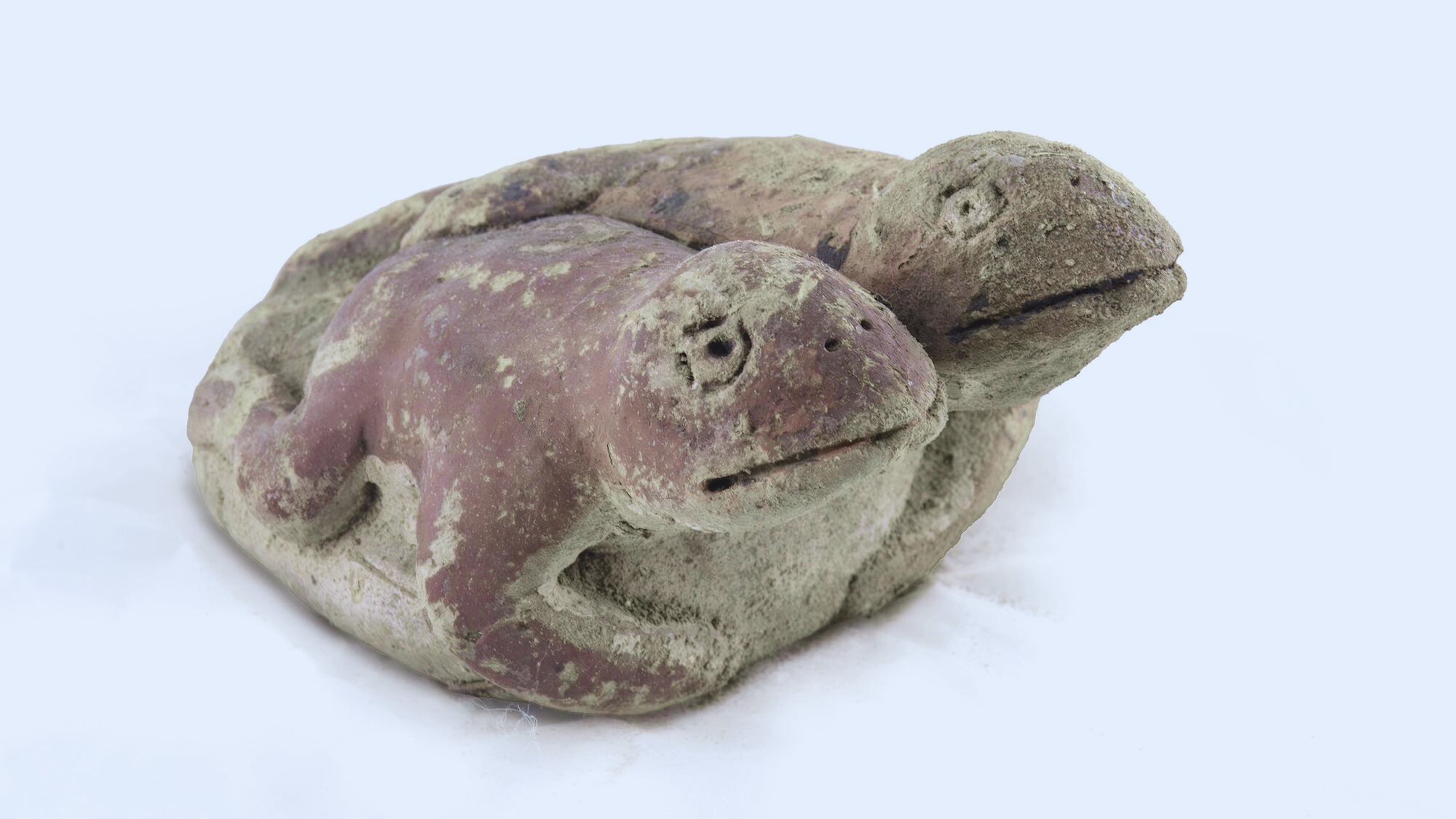
The Americas’ oldest known civilization had a thing for frogs. At an archaeological site about 68 miles north of Lima, Peru, investigators recently discovered a first-of-its-kind statue attesting to the Caral people’s affinity for amphibians. The tiny, symbolic artwork and other discoveries presented at a recent Ministry of Culture press conference highlight 18 years’ worth of excavation, conservation, and research at Vichama, a site inside the Caral Archaeological Zone (ZAC) in Peru’s Huaura Valley.
The Caral civilization
Also known as Norte Chico, the Caral civilization existed almost 5,000 years ago, placing the Andean culture alongside the rise of ancient Egypt. The Caral people represent the earliest known example of a complex society in the Americas, with experts often comparing their advancements to those in the Indus Valley and Mesopotamia.
At its height, the Caral civilization included an estimated 30 urban centers linked by trade, agriculture, fishing, and religious beliefs across present-day Peru’s north-central coast. The Caral managed these expansions without ceramics or widespread warfare. Despite this, the Caral’s influence reverberated into the Chavín and Moche peoples, as well as the later Inca Empire.
Stories of ‘shortages and hope.’ And frogs.
Archaeologists have spent nearly two decades combing through the Vichama site, which served as an urban agricultural and fishing hub around 1,800 BCE. Vichama featured at least 28 major structures including public buildings, homes, and ceremonial plazas within an area of only about a tenth of a mile.
Experts highlighted a pair of unfired clay models of buildings that emphasize the Caral culture’s understanding of urban planning and symbolic value. But the team placed particular importance on a remarkably well-preserved, 4.72 inch long sculpture of two frogs joined at the hind legs. The discovery is the first artwork of its type found at a Caral site, and speaks to the amphibians’ cultural significance.
“In the Andean cosmos, frogs are associated with water and rainfall, essential elements for agricultural cycles and survival in ancient societies,” lead archaeologist Tatiana Abad said during the press conference.
According to ZAC director Ruth Shady Solís, the clay statuette aligns with Vichama’s previously excavated carvings and reliefs that focus on the transition between eras of scarcity and plenty. For example, a “monumental composition” known as “The Dance of Life and Death” consists of 34 mural reliefs that depict emaciated corpses, pregnant women, ritual dancers, and a pair of large fish. Another, later composition called the “Humanized Toad” showcases an amphibian with human hands next to a geometric lightning bolt.
A resonating, ribbeting message
Archeologists believe these permanent building installations were intended as vital ideological reminders for future generations about the importance of solidarity, resilience, and responsibility amid ecological hurdles.
“They narrate stories of shortages and hope in the face of climate shifts, demonstrating how ancient societies adapted to challenges that are still relevant today,” said Solís.
ZAC’s director added that Vichama’s artwork is a poignant reminder of humanity’s ongoing relationship to environmental struggles.
“This discovery reminds us that ancient societies faced environmental struggles much like our own,” she said. “Their resilience and ability to embed these concerns into their cultural expressions make them a mirror for today’s world.”

More deals, reviews, and buying guides
