

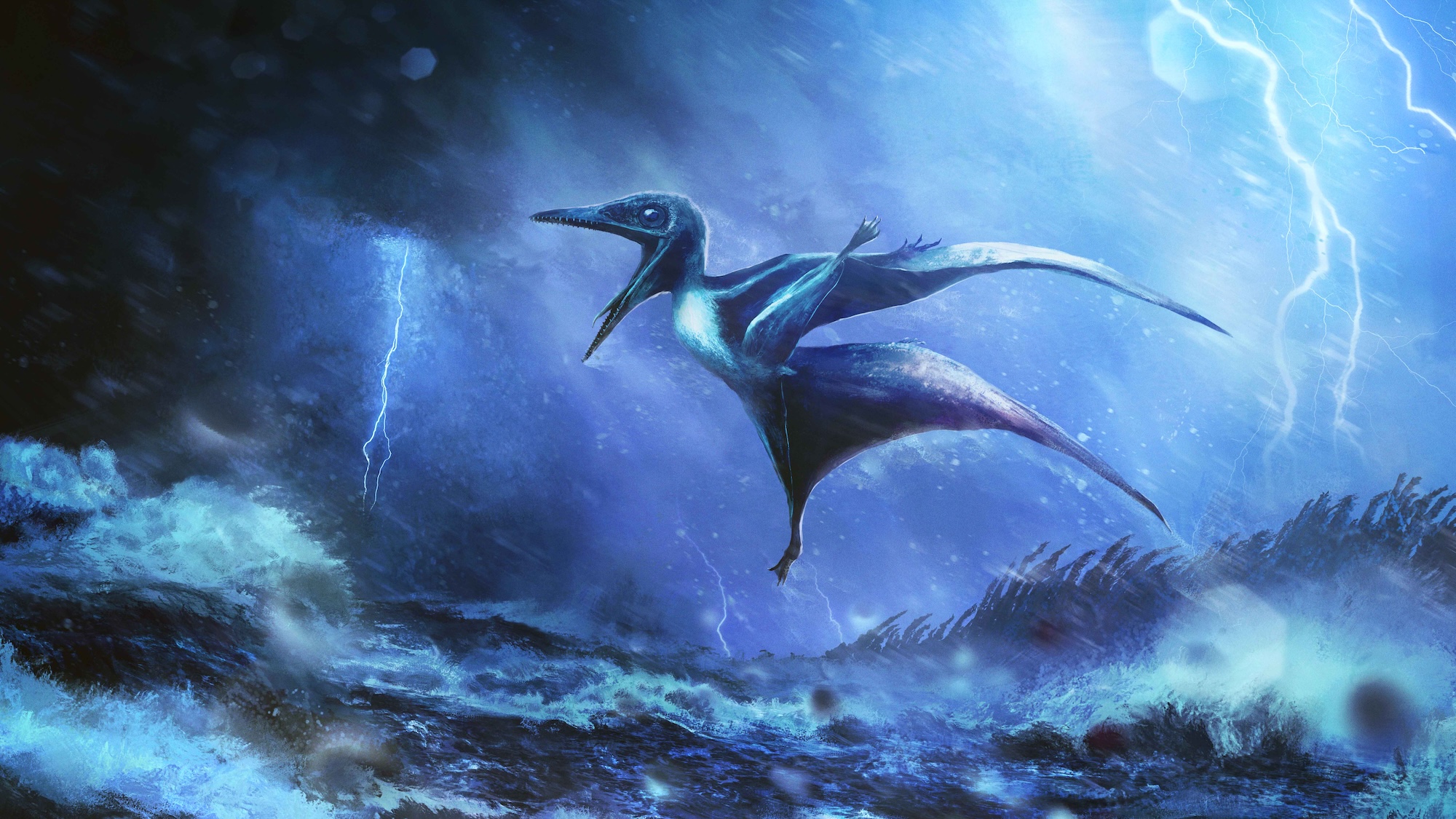
One hundred and fifty million years ago, a destructive tropical storm blew across present-day Germany and took the lives of a pair of baby pterosaurs (Pterodactylus). The wild weather created the perfect preservation conditions for paleontologists to study the dynamic duo. Their findings, published on September 5 in the journal Current Biology, could help rewrite our understanding of ancient European ecosystems and the animals that inhabited them.
The Mesozoic Era’s lesser known stars
The Mesozoic era is frequently associated with massive dinosaurs such as Tyrannosaurus rex and Ankylosaurus, but the landscape was populated by fauna of all sizes. Because fossilization favors larger, stronger creatures, it’s often difficult to assess the time period’s smaller and more fragile and thin-boned species.
This famously isn’t the case at southern Germany’s Solnhofen Limestones. Once covered in lagoons, the region provided an ideal resting place for tinier Mesozoic dinosaurs, including pterosaurs. But the area has also long puzzled paleontologists—while experts have uncovered hundreds of young pterosaur fossils over the decades, adult remains are much more rare. And when mature pterosaurs are excavated, it’s usually skull or limb fragments, contradicting the trend towards larger fossil preservation found elsewhere. According to study co-author and University of Leicester paleobiologist Rab Smyth, this is at least somewhat understandable for the flying dinosaur species.
“Pterosaurs had incredibly lightweight skeletons. Hollow, thin-walled bones are ideal for flight but terrible for fossilisation,” he said in a statement. “The odds of preserving one are already slim and finding a fossil that tells you how the animal died is even rarer.”
A stroke of good luck
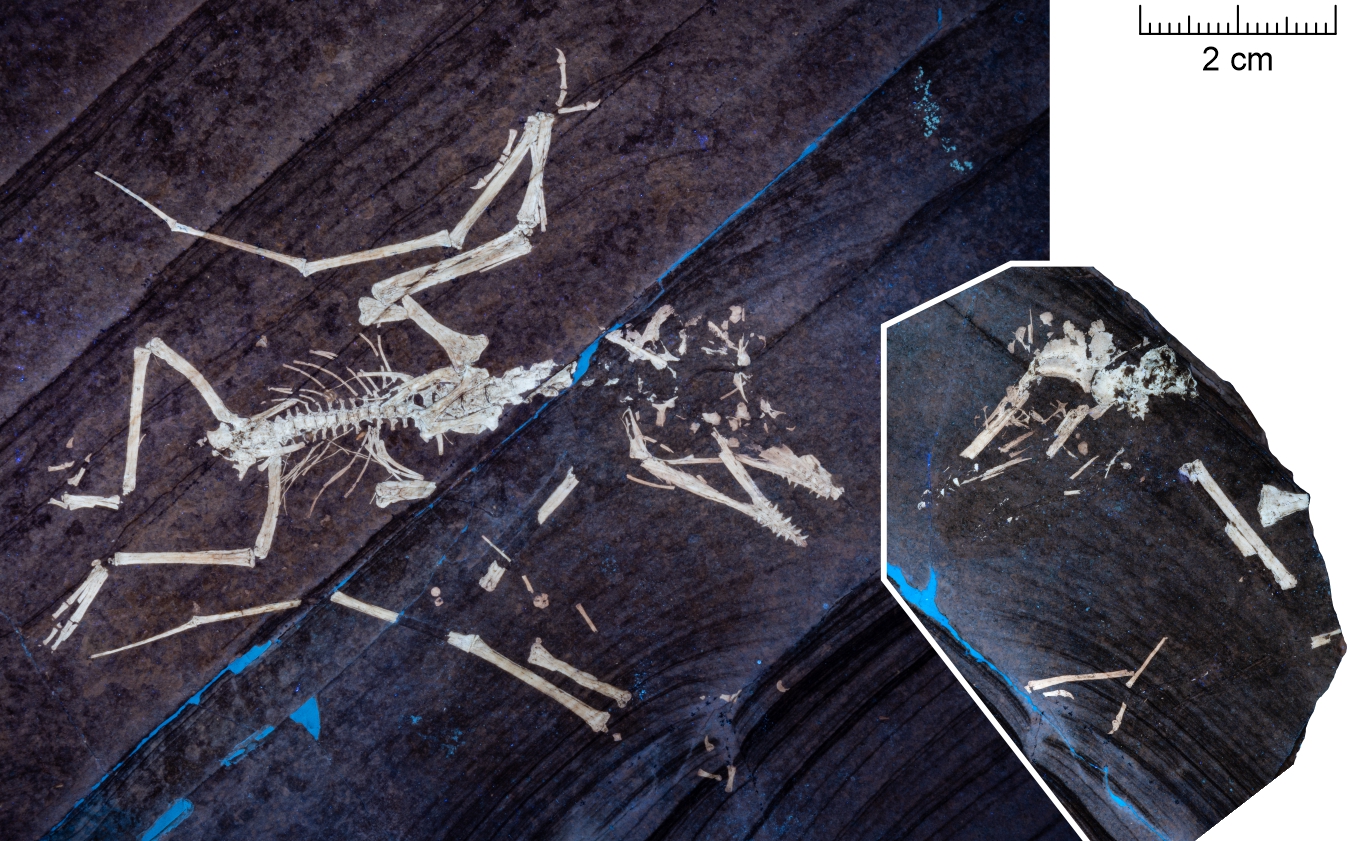
Still, it stands to reason that paleontologists should have uncovered at least a few more fully grown pterosaurs by now. However, a pair of striking discoveries recently helped Smyth and colleagues piece together the puzzle. Two complete, articulated, and well preserved infant pterosaurs were dug up about 50 miles south of Nuremberg. The team ironically dubbed the pair Lucky I and II, yet Smyth didn’t spot both of them at the same time.
“When Rab spotted Lucky we were very excited but realized that it was a one-off. Was it representative in any way?” recounted study co-author David Unwin. “A year later, when Rab noticed Lucky II we knew that it was no longer a freak find but evidence of how these animals were dying.”
A closer inspection indicated that both Luckies had wingpans of less than eight inches, making the pterosaurs only a few weeks or days-old and some of the smallest ever excavated. Both exhibited the same distinct injury: a clean fracture to the humerus. In Lucky I’s case, it occurred in their left wing, while Lucky II sustained the break in its right.
Death and discovery
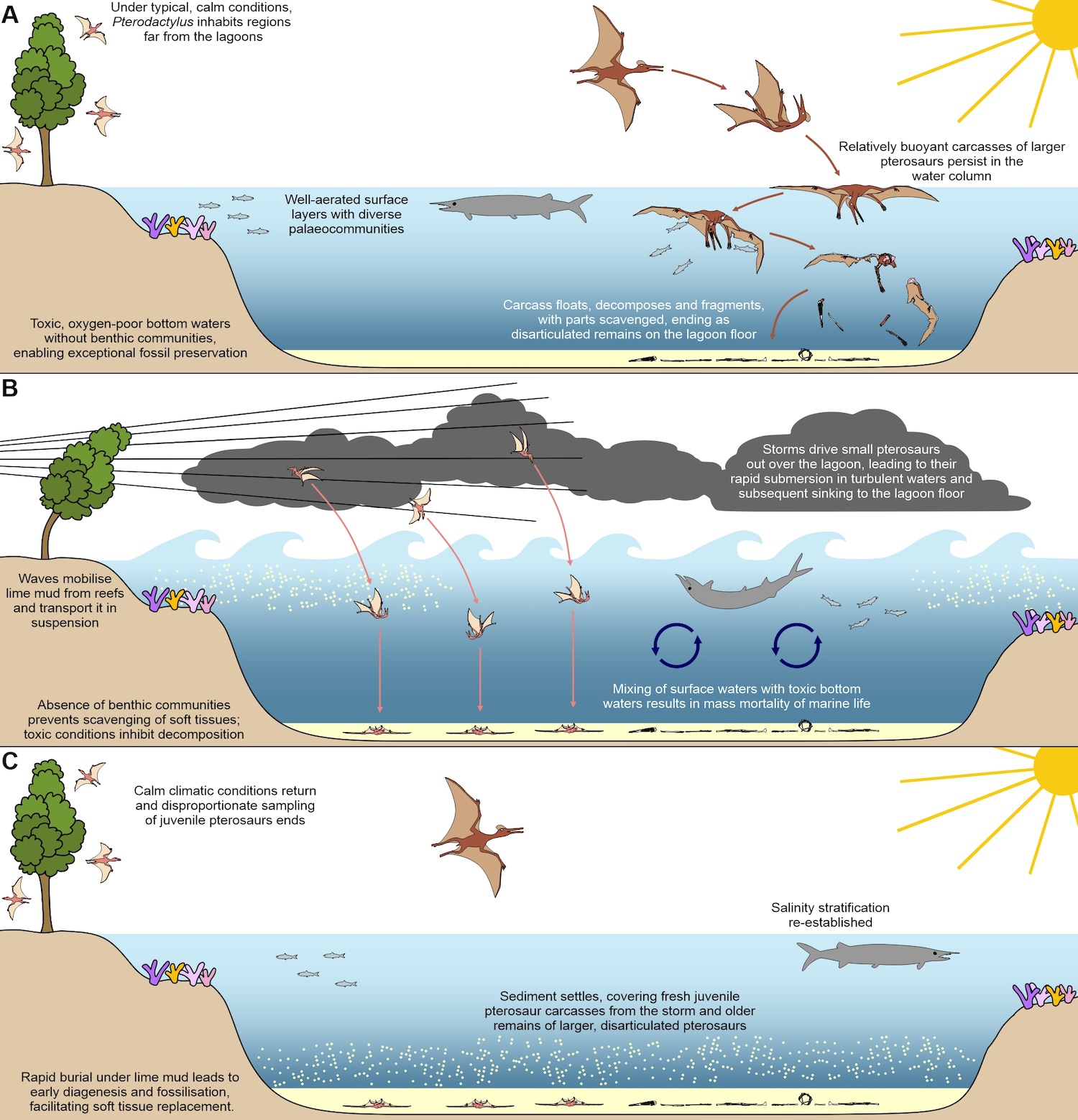
Smyth and Unwin believe the culprit is clear: a violent tropical storm’s wind gusts twisted the dinosaurs’ limbs, as opposed to a collision with a hard surface. The fatal injuries then sent the pterosaurs spiraling into the lagoon, where they quickly drowned, sank to the bottom, and were buried in fine, lime-heavy mud. These same turbulent conditions allowed for their pristine preservation, keeping them intact for 150 million years.
The study authors theorize that Lucky I and II weren’t rare occurrences. If anything, similar storms are likely to blame for Solnhofen’s many other young pterosaur remains, while the adults were often strong enough to weather the brutal wind and rain. When those dinosaurs did die , they probably floated for days or weeks atop the calm lagoon waters before depositing portions of their carcasses as they decomposed.
“For centuries, scientists believed that the Solnhofen lagoon ecosystems were dominated by small pterosaurs. But we now know this view is deeply biased,” Smyth explained. “Many of these pterosaurs weren’t native to the lagoon at all. Most are inexperienced juveniles that were likely living on nearby islands that were unfortunately caught up in powerful storms.”
Nature’s never been forgiving, but at least Lucky I and Lucky II’s eventual demise leaves valuable records for researchers to discover millions of years later.
