

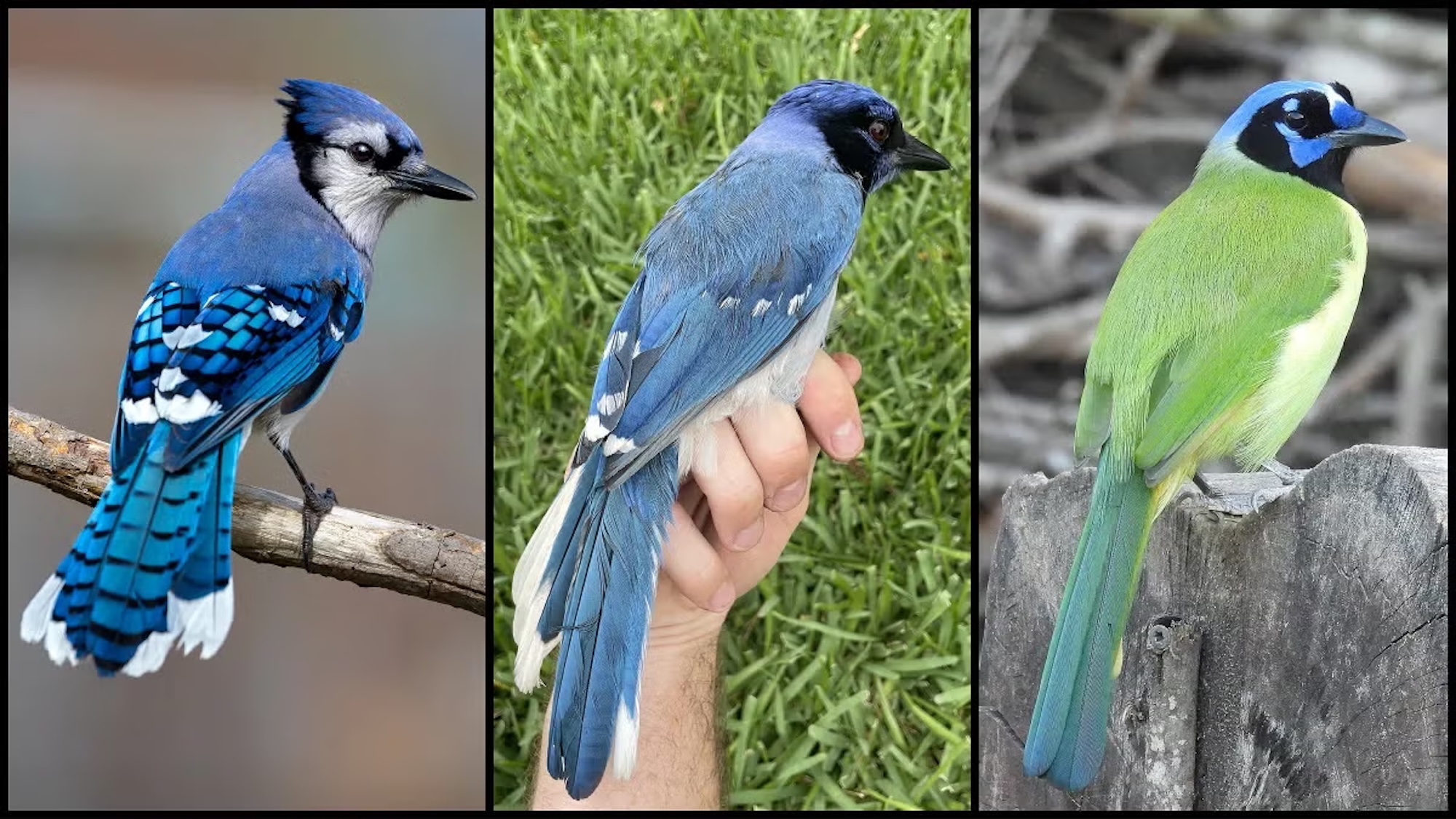
If you happen to find yourself in south Texas and spot a strikingly colored bird, be sure to snap a photo. According to biologists at the University of Texas at Austin, it may be a mix between a green jay (Cyanocorax yncas) and a blue jay (Cyanocitta cristata). Unofficially dubbed a “grue jay,” the bird likely marks one of the first confirmed examples of a vertebrate animal that hybridized partially due to climate change.
This tale of two jays began around 7 million years ago, when both species split off from their ancestors on their own evolutionary paths. Green jays are tropical birds native to Central America whose range previously extended about as far as the United States-Mexico border. By comparison, their blue jay cousins are known to generally prefer the more temperate environments of the eastern US, and rarely fly further west than Houston, Texas.
Although the two species haven’t interacted for millions of years, climate change’s influence on average temperatures in the region is forcing a reunion. Environmental scientists have documented green jays migrating further north and blue jays moving west. The birds can be now found commingling around the San Antonio area—and have the offspring to prove it.
A spotting in San Antonio
The tip-off came from a grainy photo posted online. UT Austin ecologist and green jay researcher Brian Stokes often relies on hobbyist birding online communities for directions and tips for his work. In May 2023, Stokes noticed an unfamiliar bird with a white chest and black mask in a picture uploaded to the Facebook group “TEXBIRDERS.” Although it somewhat resembled a blue jay, he knew it must be something else. A few weeks later, Stokes was in the birder’s suburban San Antonio backyard trying to find the mystery creature.
“The first day, we tried to catch it, but it was really uncooperative,” Stokes recounted in a statement. “But the second day, we got lucky.”
After ensnaring the bird in what’s known as a mist net—a rectangular crosstitching of black nylon threads tied between two poles—Stokes quickly collected a blood sample, banded its leg for future identification, and released it. From there, he and colleagues conducted a genetic analysis to confirm the bird’s identity. Their results published on September 10 in the journal Ecology and Evolution confirm the first hybrid grue jay ever seen in the wild.
A history of hybridization
Researchers have documented numerous examples of animal hybrids in the wild. These events often follow the introduction of an invasive species. Other cases—such as previously described polar-grizzly bear mixes—can happen after one species’ range expands into the other’s.
“Hybridization is probably way more common in the natural world than researchers know about because there’s just so much inability to report these things happening,” explained Stokes. “And it’s probably possible in a lot of species that we just don’t see because they’re physically separated from one another and so they don’t get the chance to try to mate.”
The only other documented example of a grue jay occurred during the 1960s. However, in that instance, researchers intentionally crossbred a green jay mother and blue jay father. The San Antonio grue jay seems to be the first known instance of a hybrid borne from the shifting migrations of both parent species. According to Stokes and colleagues, the original taxidermied specimen now housed at the Fort Worth Museum of Science and History looks very similar to one they spotted in the backyard.
After releasing the wild grue jay in 2022, the historic bird’s fate remained a mystery for years. However, Stokes noted it suddenly made a reappearance this past June—and in the same backyard, no less.
“I don’t know what it was, but it was kind of like random happenstance,” said Stokes. “If it had gone two houses down, probably it would have never been reported anywhere.”
