

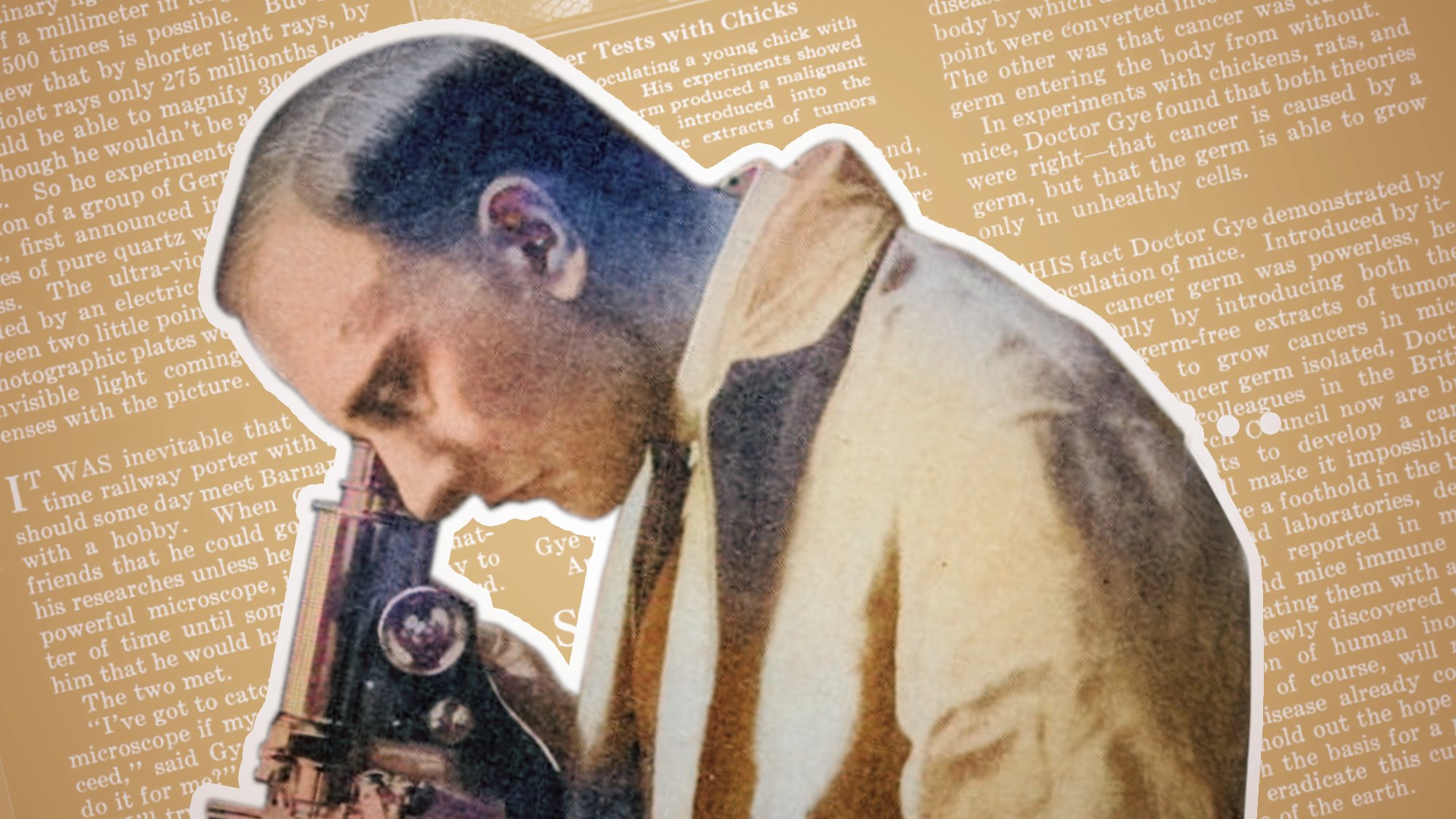
In 1925, The Lancet, one of the world’s most prestigious medical journals, published a blockbuster finding so significant that its editors offered a rare prelude: “The two communications which follow mark an event in the history of medicine. They form a detailed description of a prolonged and intensive research into the origin of malignant new growths, and they may present a solution of the central problem of cancer.”
On the day the studies were scheduled to be released, word began to spread beyond the scientific community. “A crowd gathered in a street outside the office of The Lancet,” wrote Peter Vischer for Popular Science. “At first it was just such an indescribable gathering as happens hundreds of times a day, for no particular reason, in New York, or Chicago, or San Francisco. But this crowd swelled minute by minute until it bulged through the Strand and disrupted the normal traffic of the street.”
The crowd, Vischer explained, “was quiet and patient, throbbing with a deep excitement.” The rumor electrifying London was that the cancer “germ” had been spied under a microscope for the first time.
By the 1920s, the discovery of new germs had become almost routine. For nearly half a century, during the so-called golden age of bacteriology, scientists had been busy identifying the microbes responsible for many of humanity’s deadliest afflictions. Cholera, tuberculosis, tetanus, pneumonia—all had been traced to specific “germs.”
A new germ discovery, even for a disease as feared and poorly understood as cancer, might have been just another headline. What set this announcement apart, however, was the unlikely researchers behind the discovery: a well-regarded London hatter and a former railway station clerk, both outsiders to the formal medical establishment.
The hatter and railway clerk who transformed cancer research
Joseph Edwin Barnard, the hatter, led what might be loosely described as a Jekyll-and-Hyde sort of life—though without the gothic horror elements of Robert Louis Stevenson’s iconic 19th century yarn. By day, Barnard made hats in the distinguished London hattery, J. Barnard & Sons, founded by his father. By night, he rushed to his private laboratory, driven to unmask ever-smaller microbes. Barnard tinkered with novel microscopy techniques, including ultraviolet light and photographic plates, developing custom lenses and equipment to see beyond the limits of conventional optics.
The former railway station clerk William Ewart Gye’s path to medicine was just as unconventional and far more mysterious—something that might have puzzled even Arthur Conan Doyle’s formidable 19th century detective, Sherlock Holmes. Born in 1889 as William Ewart Bullock, the railway clerk changed his surname to Gye in 1919. The reasons remain murky.
One theory suggests that Gye wanted to avoid confusion with William Bulloch, a prominent bacteriologist at London Hospital and a professor emeritus at the University of London. Another theory suggests that in a show of support he took the surname of his wife, Elsa Gye, a fascinating suffragette who had reclaimed her maiden name after campaigning for women’s right to vote. Taking his wife’s name also happened to neatly clear up the name confusion that dogged Gye.
However, Popular Science reported an even more mysterious story behind the name change—that an ailing benefactor named William Ewart Gye (who confusingly had the same first name and middle name as the microscope-obsessed Gye) financed Gye’s medical education and early cancer research, and that Gye changed his name in gratitude. Yet another theory suggests that the benefactor was not an acquaintance, but rather Gye’s father-in-law. Whatever the truth, the name change only intensified his enigmatic reputation in the medical community.
Related Archival Stories
How an unlikely team-up advanced cancer research
When Gye and Barnard first met in London, their partnership fused two complementary skillsets sorely needed at the time to advance cancer research: Gye’s mastery of experimental biology and germ theory, which he had acquired through long hours in the lab, and Barnard’s exceptional skill with microscopes and imaging techniques. Together, the unusual duo set out to solve cancer’s mystery.
Their collaboration built on decades of progress that began in the 1870s when Robert Koch, a doctor from East Prussia, developed pioneering techniques to view “germs” under his microscope. Koch’s novel contributions, which included using dyes to improve specimen contrast, and microphotography to capture microbial images, led to the discovery of anthrax and other pathogens. At the same time, French chemist, Louis Pasteur, was developing vaccines based on these discoveries.
By the 1920s, science and medicine were driven by a fairly straightforward premise: find the germ, the cure will follow. That’s why Gye and Barnard’s discovery of “particulate bodies” was announced by The Lancet’s editors as “an event in the history of medicine.” Barnard’s article in The Lancet included photographs of what they had captured under his microscope. Some cells “appear to have a thickened wall,” Barnard wrote, “while others are thin and of low visibility.” Barnard believed this difference in thickness came from the virus replicating within the cell walls.
By confirming the presence of a cancer virus, the hope and expectation was that a cancer vaccine would soon be on the horizon. As Vischer reported for Popular Science in October 1925, “Gye and his colleagues in the British Medical Research Council now are busy with experiments to develop a cancer vaccine that will make it impossible for the germ to secure a foothold in the body.”
Though Barnard was considered an amateur by the medical establishment, his moonlighting contributions were extraordinary. By combining ultraviolet light with custom, precision lenses, he created instruments sensitive enough to capture individual microorganisms. To do so required special ultraviolet light with very short wavelengths measured in the billionths of meters—the smaller the wavelength, the smaller the object that can be seen. Barnard’s microscope was the first to achieve such fine-grained resolution.
Meanwhile, Gye’s painstaking research led him to propose a two-factor theory of cancer, which he described in The Lancet in 1925. “The virus alone is ineffective,” Gye wrote. “A second specific factor, obtained from tumour extracts, ruptures the cell defences and enables the virus to infect.”
His theory suggested that cancer did not arise from a germ alone, like tuberculosis. Nor did it solely originate from damaged cells or external irritants (what we today would call carcinogens). Instead, cancer, he theorized, arose from the interaction of cells damaged by outside factors and a virus. Gye’s experiments showed that he could not produce a tumor using just a virus-containing liquid or just an extract of tumor tissue. But when he combined these two factors, tumors reliably formed in chickens.
How cancer research today builds on Gye and Barnard’s work
Gye’s two-factor theory wasn’t entirely correct, but it pointed cancer researchers in the right direction. A century on, we still don’t have “a solution of the central problem of cancer.” Nevertheless, it’s safe to say that The Lancet’s prelude was not hyperbolic. As the editors suggested, the discovery would prove to be one of the most profound events in medical history, setting the stage for modern cancer research at the molecular level.
Today, we know that cancer is not a single disease caused by a specific germ coupled with damaged cells or outside irritants, but rather a complex group of diseases driven by genetic mutations, environmental factors, and, in some cases, viruses such as HPV (human papillomavirus) or EBV (Epstein-Barr virus). Instead of hunting for a single germ, modern cancer researchers point their powerful lenses on the internal machinery of cells. Today, tools like electron microscopes and super-resolution imaging are used to suss out internal cellular structures and molecular pathways that control cell growth and death.
While the optimism of 1925 has been tempered by a century of complex discoveries without a simple solution, enormous progress has been made in cancer prevention, early detection, and treatment. Even though cancer remains a leading cause of death, life-prolonging treatment protocols have emerged to transform patient outcomes and offer real hope for the future. In the end, Gye’s and Barnard’s discovery wasn’t just about seeing a cancer germ for the first time, it was about what science can achieve when it remains accessible to outsiders and mavericks with the passion and determination to make a difference.

More deals, reviews, and buying guides
