

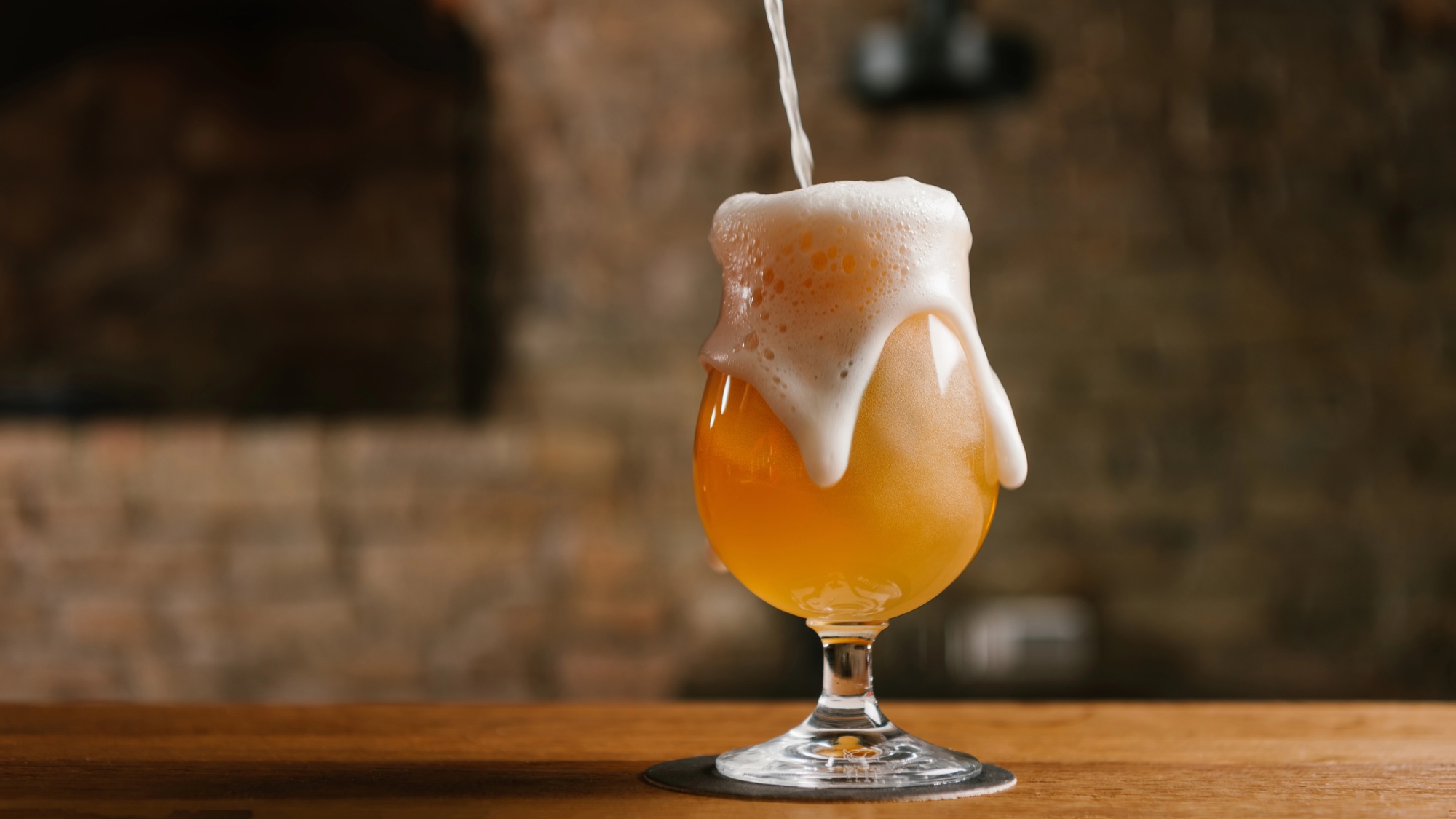
There’s a lot of physics going on inside a cold glass of beer. This is especially the case right after the initial pour, when the pint (hopefully) amasses a frothy head of foam. “Hopefully” is the key word here, because amassing that perfect bubbly top is sometimes harder than it seems.
Experts in both the laboratory and brewery understand that barley protein affects a bubble’s surface viscosity and tension. For years, the assumption has been that beer foam stability mainly stems from the interactions between these bubbles’ protein-rich surface layers. But after numerous experiments (and countless critical test pours) researchers are now better understanding beer foam’s underlying mechanics. The findings published on August 26 in the journal Physics of Fluids may soon extend beyond better brews.
An idea is brewing
The investigation began roughly seven years ago, when a team of collaborators from ETH Zurich in Switzerland and the Eindhoven University of Technology in the Netherlands joined together to get a better handle of foam’s behavior.
“The idea was to directly study what happens in the thin film that separates two neighboring bubbles. And the first thing that comes to mind when thinking of bubbles and foams is beer,” Eindhoven University of Technology materials scientist and study co-author Emmanouil Chatzigiannakis said in a statement.
Chatzigiannakis and his colleagues then combined intricate imaging techniques and rheometry (the study of the flow of matter) to analyze a lot of beer.
“We can directly visualize what’s happening when two bubbles come into close proximity,” said Chatzigiannakis. “We can directly see the bubble’s protein aggregates, their interface, and their structure.”
Protein-powered fermentation
The team eventually determined that while protein viscosity is definitely a factor, its influence on foaming diminishes depending on how many times a beer undergoes fermentation. For example, a single-fermentation lager’s bubbles are largely affected by proteins. The more proteins there are, the more viscous and stable a foam.
Multi-fermentation brews such as complex, flavorful Belgian Trappist beers are a different story. A renowned specialty of the monastic order of the same name, a Trappist’s surface viscosity is much less influential. However, these proved to be the beers possessing the most stable foam structures. How is that possible?
It still comes down to protein content in the beer, but somewhat contrary to previous assumptions. The team identified lipid transfer protein 1 (LTP1) as the primary determinant in beer foam stabilization.
In single-fermentation beers, LTP1 proteins exist in their original form as tiny, spherical particles that arrange close together on a bubble’s surface. This creates a two-dimensional suspension, with finely spread solids mixed into a liquid to stabilize foam.
In beers that undergo a second fermentation, yeast cells start denaturing those LTP1 proteins and altering their structures into a kind of membrane or net, further stabilizing the bubbles.
Repeat the fermentation a third time, as is the case in a Trappist beer, and the LTP1 proteins are so deteriorated that their fragments exhibit both a water-repellent and water-attracting end. The subsequent interactions reduce surface tension and maximize a foam’s stabilization potential through what’s known as Marangoni stresses–the forces created in surface tension differences.
“These protein fragments function like surfactants, which stabilize foams in many everyday applications such as detergents,” explained ETH soft materials scientist and study co-author Jan Verman.
Safer, sustainable foams
According to Verman, the team’s observations underscore that foam doesn’t get its stability from linear, individual factors and interactions.
“For example, increasing the viscosity with additional surfactants can actually make the foam more unstable because it slows down the Marangoni effects too strongly,” he said. “The key is to work on one mechanism at a time – and not on several at once.”
A better grasp of foam mechanics won’t only make for more satisfying beers. It could save lives. Lubricants inside electric vehicles are sometimes prone to foaming, which increases the chances of a chemical fire. Meanwhile, many surfactants still rely on ecologically harmful fluorine and silicon. Developing foam-free lubricants and green surfactants could help multiple industries become more sustainable.
“Our study is an essential step in this direction,” said Vermant.
