


“Traveling to attend protests and support political actions can be a meaningful way to act in support of your values.”
T
he first time I attended a protest on a trip was in January of 2024. I was visiting New York and wanted to stand with those opposing America’s supplying Israel with weapons to attack Palestinians in Gaza. I was back in New York exactly a year later, on January 20, 2025. Inauguration Day. Again, I searched Instagram to find a protest and joined roughly 300 crestfallen New Yorkers and Susan Sarandon for an event approximating a funeral.
Since then, I traveled to Denver for the “Hands Off!” rally in April, where I was one of roughly 10,000 protesters.
Then it was off to the Florida Everglades for the so-called “Alligator Alcatraz” ICE immigrant detention center/concentration camp in July. I was the sole protestor on that day.
Observing America’s crisis of democracy worsening, I have begun not only making time on previously scheduled trips for protests, but I’ve also started timing trips around protests. I rebooked a flight home from Albuquerque in October to be on the ground and not in the air for a No Kings event. I tacked three days in Chicago onto a St. Louis trip to join protestors at the Broadview, Illinois, ICE “detention center.”
Continue Reading Article After Our Video
Recommended Fodor’s Video
Coincidentally, in Chicago, I was staying only a block from the federal courthouse where U.S. Border Patrol Commander-at-large Gregory Bovino appeared before a judge on October 28 to explain his service’s and his personal actions regarding protestors, actions that routinely feature chemical weapons. I stood in solidarity with a handful of protestors at the entrance to the courthouse.
Canceling a trip to Nassau, Bahamas in late November in favor of visiting Portland, Oregon, to join ICE protests there, it occurred to me: I am a protest tourist.
Is that a thing?
Should it be?
Protest Tourism
The term “protest tourism”–you read it here first–sounds gross. Participating in a protest isn’t an optional itinerary item at an all-inclusive resort: 1:00 p.m.–snorkeling excursion or staring down masked federal agents carrying assault rifles.
“Tourism” has come to imply beaches and rum drinks and frivolity.
This is no game. Protestors are tear-gassed, shot at, assaulted, and arrested almost daily in America. Men, women, clergy, the elderly.
I am a healthy middle-aged male. I assume fewer physical risks when joining a protest than most. Because of my race, too. I’m white.
With those privileges, I feel especially compelled to place myself where fascism is being resisted. I go more safely where others meet grave danger.
If not “protest tourism,” how about “protest travel?”
I like that.
People travel for all kinds of deeply meaningful reasons. People travel to trace their genealogy. People travel to perform volunteer work. People travel to difficult sites of Civil Rights history, like Montgomery, Alabama. To difficult sites of Native American history like Bosque Redondo in New Mexico. To difficult sites of world history like the death camps in Poland.
More tears than selfies.
Yet people go. By the millions. They go because it matters. It matters to witness. It matters to stand on that ground and honor the sacrifice. The bravery.
Protest travel accomplishes that in real time. Showing up to stop or slow barbarity before it’s too late.
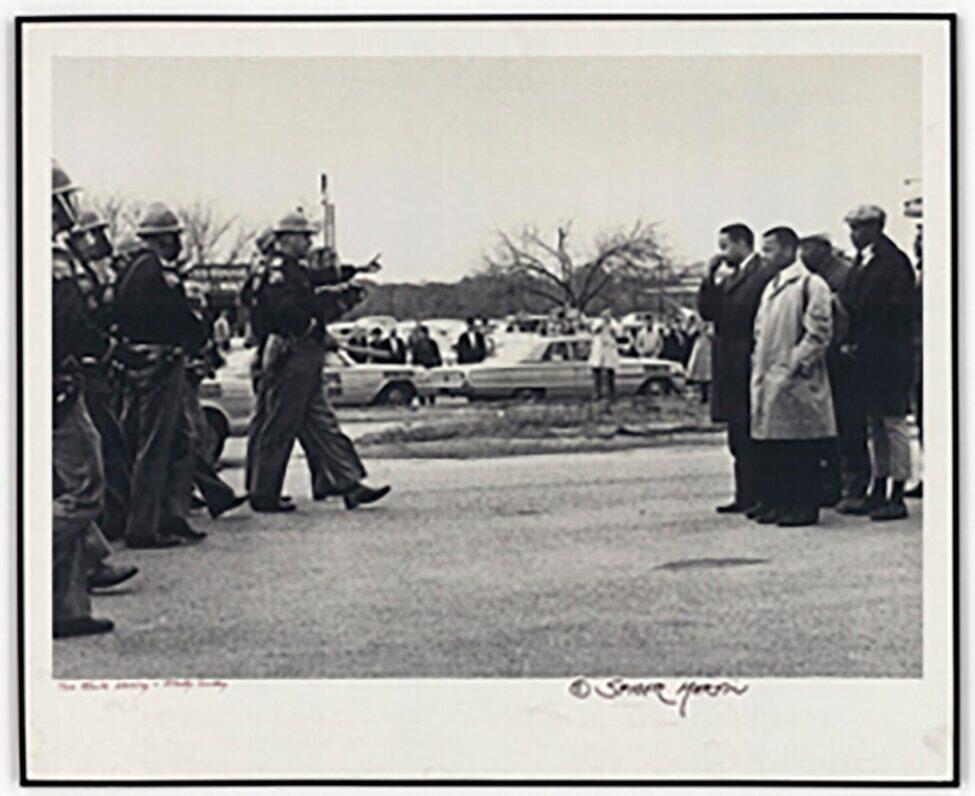
I distinctly remember my Civil Rights lessons from sixth grade. Selma. Bloody Sunday. Nothing struck me more profoundly than the “Two Minute Warning” photograph taken on the Edmond Pettus Bridge. Armed cops wearing helmets and gas masks on the left side. White. Unarmed Black folks on the right. Literally and figuratively.
I vowed to myself as a 12-year-old that if the scene were ever to be repeated in America, I would place myself on the right side.
I’m no hero like they were. I’ve never felt a police baton crack on my skull. I’ve yet to inhale tear gas as they did, and the protestors in Broadview have. I was in Broadview on a Sunday and Monday afternoon. The scene was not roiling with citizens and cops like you’ve seen on social media. I was one of about a dozen people, yet we received a “two-minute warning” at 6 o’clock from Broadview police.
At 6 p.m. in Broadview, Illinois, the First Amendment and right to peaceably assemble were revoked until 9 a.m. the following morning.
Escapism vs. Engagement
I don’t discount the need for escapism and travel’s role in that aspect of self-care.
When I went to Chicago, I didn’t only spend time in Broadview. I ate deep-dish pizza at Pequod’s. I indulged in a Brownie Old Fashioned at the Palmer House. I went to an art museum.
Traveling to protest doesn’t require an absolute time commitment any more than seeing the death camps need be the only thing you do in Poland.
I enjoyed myself when not behind concrete barricades. And in those hours standing, I met good people. I was welcomed as an outsider in solidarity with our struggle. No one wants to host a “party” and have nobody show up. If you support a protest from out of town, your presence will be appreciated.
One tip: read the room. Your level of agitation should match those around you. You’re there in solidarity, not to stand out.
As a travel writer, I recognize another one of my great privileges: I travel constantly.
I don’t have to prioritize how to use a limited supply of company-allocated “vacation days.” I followed up my visit to Broadview with five days in the Azores a week later.
Plus, I don’t have kids.
I’m not telling you how to travel. You want to go to Mazatlán and never leave the pool, do that.
I do want to stress the importance of engaging. The importance of doing more than just talking about your values– but about being about your values. Nothing changes when you don’t act. Travel isn’t the only action you can take in support of your beliefs, but it is an action you can take towards shaping the world you’d like to see.
