

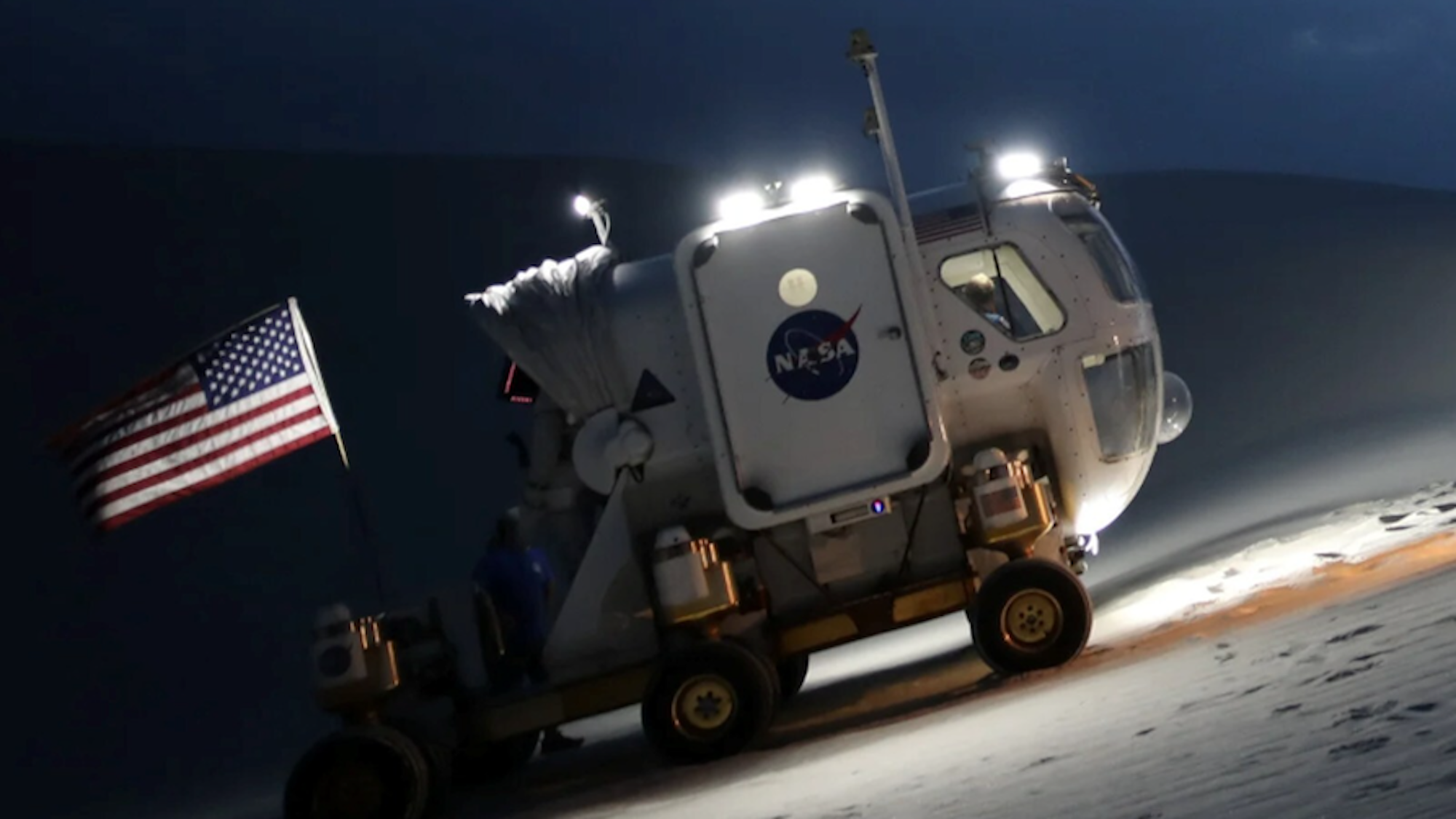
With about two-and-a-half years to go until a planned crewed-mission to the moon, NASA is still deciding which company will receive a greenlight to build the Artemis program’s lunar terrain vehicle (LTV). In the meantime, they’re also on the lookout for a good set of tires. Last week, the agency opened submissions for its “Rock and Roll with NASA Challenge,” a competition to see who can design the impending LTV’s four wheels.
A lunar rover doesn’t simply sport a set of super-durable rubber tires. Engineers must consider a unique set of challenges in order to ensure the safety of astronauts as they navigate the harsh, dusty lunar terrain at one-sixth Earth’s gravity. While plenty of prototypes exist, the last rover tires to actually touch down on the moon arrived on the Apollo 17 mission in 1972. The LTV included on NASA’s long-awaited lunar return will need to account for the same conditions experienced on previous visits, while also factoring in new considerations.
“NASA is returning crews to the Moon to establish an enduring, science-driven presence that will serve as the springboard to Mars,” the challenge planners explained in their open call announcement. “Central to that ecosystem is mobility, and innovation in mobility will be key to maximizing exploration returns.”
NASA noted that Apollo’s rovers tripled the range that astronauts could reach in only their suits. After over 50 years of additional research, discoveries, and technological breakthroughs, the plan is now to go where no lunar rover has gone before. Artemis cargo landers will deliver equipment to sites along the moon’s polar highlands, while crew members will complete daily sample retrieval runs. Astronauts will also require quick transit between lunar locales.
“The challenge is a constant trade among traction, mass, materials, and durability,” NASA said.
Artemis’ LTV wheels will need to handle off-road lunar expanses covered in plumes of sharp, electrostatically charged regolith, along with temperatures that regularly swing between -427 and 250 degrees Fahrenheit. While the Apollo mission’s moon buggy’s rigid spoke wheels helped max it out at 11.2 mph, NASA’s 14.9 mph speed goal for the LTV will require a totally different design that’s lighter and more flexible.
Innovators have until 5PM EST on November 4, 2025 to submit their entries for Phase 1 of the competition. Judging will begin the following day, with a set of 10 finalists to be announced on December 18. A second phase and third phase for additional testing will commence on January 2 and May 1, 2026, with a live demonstration from the winner scheduled for sometime that July. If all goes as planned (and that’s a big “if”) the wheels will be installed on the LTV accompanying Artemis V in 2030.
“For solvers, the mandate is clear: re-imagine the wheel for the lunar environment, that moves faster and works longer than anything created to-date,” NASA said.

More deals, reviews, and buying guides
