

Few films end with a line that doubles as a mission statement, distilling both the story’s themes and the creators’ intents. “Arco” fits the bill, captured in its final words: “I wish that things would change.”
“Art and activism come from the same place,” says producer Natalie Portman, citing Ava DuVernay. “Both imagine a reality beyond the one we’re living in. That’s very present in this film, which creates something beautiful while imagining a future brighter than the one we see today.”
Produced by MountainA — run by Portman and her partner Sophie Mas — and Remembers, led by director Ugo Bienvenue and his creative collaborator Felix de Givry, “Arco” has charted a remarkable path. It premiered at Cannes, was acquired by Neon, won the top prize at Annecy, received three European Film Award nominations, and continues to screen at festivals including Marrakech, with a robust awards push underway.
Remembers – MountainA
“A lot of science fiction is about wanting things to stay the same, projecting today’s world onto the future,” says Bienvenue. “Maybe we’re one of the first generations in a long time that truly wants to go in a different direction. We’re trying to find new paths because the ones we imagined before aren’t very pleasant.”
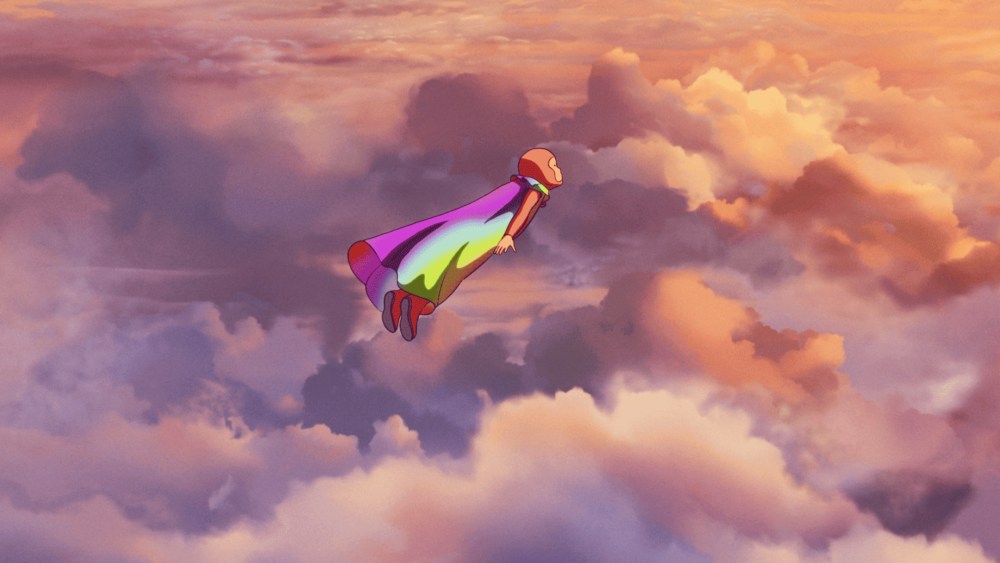
An acclaimed animator and comic book artist — who had designed the poster for the Annecy Animation Festival years before winning its top prize — Bienvenue began work on his feature debut with a single idea: to envision a utopian future shaped by the remembrance of things past. From that spark, a sci-fi fable took shape: the tale of a boy from 2932 who rides rainbows through time and forms an unlikely bond with a lonely young girl in 2075.
“It was the most beautiful thing I’d ever heard,” adds Portman. “I was blown away by the idea and the way he described imagination. It’s incredibly evocative — creating something that feels like it has always existed, as if the future is a memory. That was the moment Sophie and I looked at each other and said, ‘This has to exist. Whatever it takes, this has to exist.’”

Remembers – MountainA
The project began as a lifeline. During the long, restless days of the 2020 lockdown, Bienvenue turned to creativity as an escape. He imagined a child from a freer, happier future, thrown back into troubled times, and quickly got sketching. Soon, he enlisted his producing partner and co-writer, Felix de Givry — best known for his roles in Mia Hansen-Løve’s “Eden” and Olivier Assayas’ “Something in the Air.”
“Ugo drew while I wrote,” de Givry recalls. “We really made the film exist internally first. Normally, we share projects with the world much earlier — for funding, development, all that — but this time we stayed in our small studio with Ugo for months, crafting the film almost in secret, before it even existed for anyone else.”
The duo bucked convention, channeling their efforts into a 50-minute animatic in place of the traditional script and pitch deck. As ’90s kids, they poured into the project the influences that formed them, blending the pop-culture DNA of Spielberg, Zemeckis, and Miyazaki with the storybook mythos of “Peter Pan,” “Pinocchio,” and “The Little Prince.” The result felt at once familiar and fresh to their generational peers.
Remembers – MountainA
“When we saw the original animatic, it radiated pure entertainment, full of joy, humor, adventure, and extraordinary visuals,” says Portman. “I immediately felt that Ugo’s vision would resonate. The story of two kids on an adventure has a classic ’80s-American-export structure, yet it carries a distinctly French and uniquely Ugo sensibility. The hand-drawn 2D animation is breathtaking, and in today’s world, we crave that human-to-human touch.”
Hot off the Cannes launch of “May December,” Portman and her MountainA co-founder Sophie Mas discovered “Arco” at an auspicious moment, just as the producing partners, with footholds in both the U.S. and France, were planning the next steps for their nascent company. Shortly after joining the project, they decided to establish a Gallic outpost to produce their first animated title through the French ecosystem, all while taking cues from a more American, gung-ho approach.
“In the U.S., there’s more of a ‘don’t wait’ mentality, whereas in France, films often develop according to the opinions of many stakeholders,” Mas explains. “It was fascinating to combine our drive to act quickly with the value of the French ecosystem, which is incredibly rich. We also realized that if we wanted to pursue other projects—either with Remembers or other French directors — this would create a framework to develop work outside the U.S.”
Remembers – MountainA
Adopting a hybrid model ultimately granted Bienvenue a level of creative freedom rarely found in either system.
“Animation in France tends to be very subject-oriented, with little adventure or sci-fi, and often doesn’t focus on pleasure and fun,” Bienvenue says. “But this movie was meant for everybody from the very beginning. In France, people often start thinking small because budgets are lower than in Hollywood. It’s our job to push boundaries, to show that we can go further and aim higher.”
De Givry agrees, noting that the film’s unusual production path drew strength from both approaches. “From my perspective, the film wouldn’t have had the same life or launch if it had been done solely within the American system,” he says. “French auteur animation allows for a trajectory with international sales, distributors, and other supports that are essential for launching such a project. That reinforced our ambitious goal to finish the film for Cannes 2025 — which is almost miraculous for an animated feature —because we knew this film needed to exist right now.”
Remembers – MountainA
Indeed, the writers imagined two futures: a distant 2932 in which humanity has finally broken its cycles of ecological harm, and a nearer 2075 that amplifies the climate instability we already face. Yet during the film’s relatively brisk production, reality began to catch up to — and at times surpass — de Givry and Bienvenue’s darker projections.
At recent Los Angeles screenings, the team met filmgoers whose lives have been upended by wildfires even more devastating than those Bienvenue depicts on screen. For the filmmakers, these encounters were both sobering and unexpectedly cathartic, connecting their time-travel fantasia to the urgency of the present.
For her part, Portman was especially thrilled to watch the film with two particular audience members. “My kids are eight and 14, and they loved it,” she beams. “It also sparked important conversations between us: why are the parents not there, what is the role of technology and caretaking, and what platforms we might need to heal the Earth. Each question led to new and amazing discussions.”
Remembers – MountainA
