

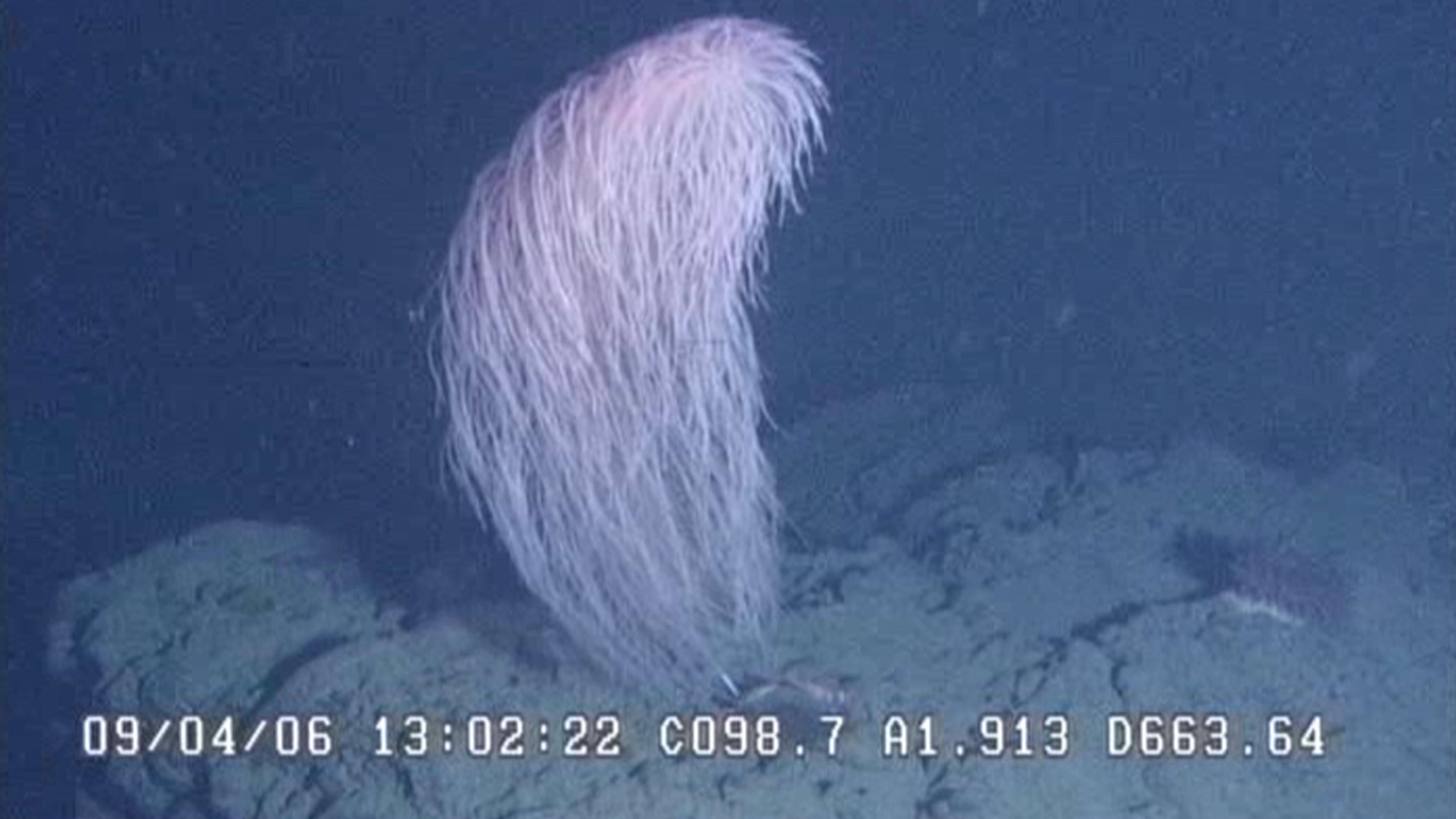
While it’s not helping fly the Millennium Falcon, marine biologists have discovered a new type of deep-sea coral in the western Pacific Ocean that bears a striking similarity to a certain beloved Star Wars character. A new scientific analysis of the species initially documented almost two decades ago indicates that Iridogorgia chewbacca is its own species, with long, hairlike branches that live up to its namesake Wookie.
I. chewbacca was actually first recorded on video during a 2006 ocean expedition near the Hawaiian island of Moloka’i. Ten years later, another example was documented close to the Mariana Trench. But it would take a few more years before University of Hawai’i ecologist Les Watling noticed the strange, ethereal sight while reviewing research from some of his colleagues. His team’s recent paper published in the journal Zootaxa marks the first description of I. chewbacca’s physical and genetic characteristics along with another novel species of coral, Iridogorgia curva.
“Seeing this coral for the first time was unforgettable,” Watling said in an accompanying statement. “Its long, flexible branches and shape immediately reminded me of Chewbacca. Even after years of deep-sea work, discoveries like this still make me stop and take notice.”
Like all coral, this Wookie-inspired example isn’t one creature. Instead, I. chewbacca is made from a colony of thousands of polyps that collaboratively form the larger structure. The Wookie-like specimen seen near Moloka’i measured about four feet tall. Its relative uncovered close to Mariana Trench was about 20 inches high. However, in both cases, their undulating branches were capable of growing up to 15 inches long. Unlike other coral species, I. chewbacca isn’t found amid extensive reefs. Instead, they appear to live alone across the rocky ocean floor.
The world’s coral, I. chewbacca included, are currently threatened by the climate crisis’ ongoing effects on ocean temperature, acidity, and pollution. But unlike Han Solo’s best friend, they’re not capable of defending themselves against the threat, and require worldwide conservation efforts to ensure their future survival. Recent breakthroughs are showing promise, however, including probiotic treatments and even appropriately Star Wars-esque cryogenic preservation techniques.

More deals, reviews, and buying guides
