

Yet another scandal has been reported in the international sports world. Earlier this month, over 2,200 people traveled from 27 countries to the car-free island of Easdale off Scotland’s western coast for the annual World Stone Skimming Competition. Held nearly every year 1983, the contest invites participants to test their skills in the “world’s first dedicated stone skimming arena,” a slate quarry that flooded in 1881.
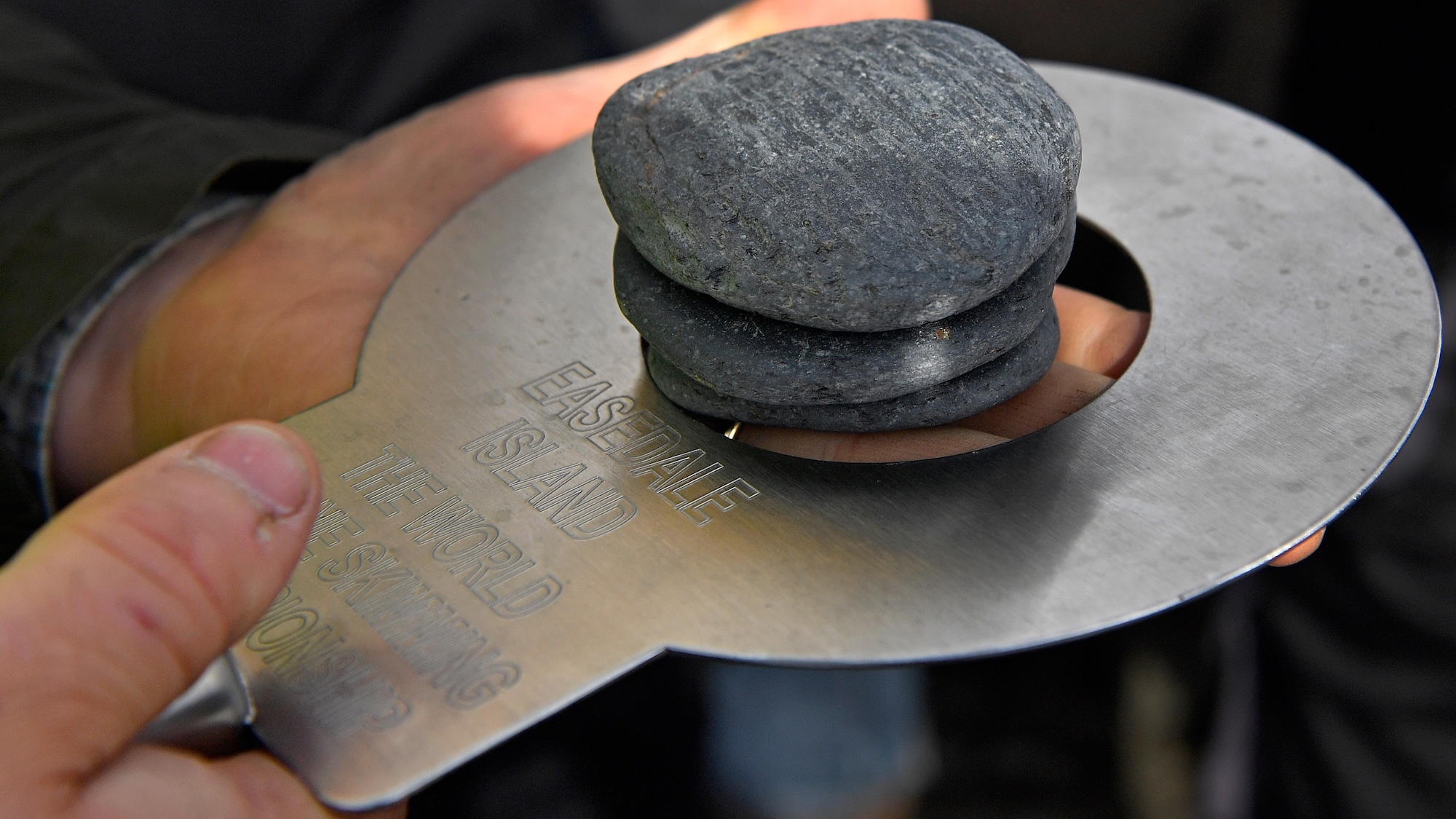
The World Stone Skimming Competition rules are clear: contestants must use unaltered stones selected from among the island’s naturally occurring slate. Judges then use a measuring device dubbed the “ring of truth” to make sure that each rock is no larger than three inches wide. Participants then attempt three skims, each of which must bounce at least twice to qualify towards their cumulative score.
But according to “Toss Master” Kyle Matthews, judges soon heard, “rumors and murmurings of some nefarious deeds.” He also added to BBC Radio’s Good Morning Scotland that “there was a bit of stone doctoring.”
Unlike the unaltered skimming stones, the stone selections in question appeared to have been ground into more circular shapes in the hopes of improving their bounce potential.
Speaking with Popular Science, Matthews—who has also served as a competition organizer for the past three years—says the discovery was a first for the championship, which also serves as a charity event for local organizations.
“This is the first time skimmers have contacted me after the event to raise their concerns,” he explains. “So I think if it had been happening in previous years they would have told me then.”
The would-be cheaters admitted to the scheme by a show of hands and apologized for their misdeeds after the judges raised their suspicions. With the investigations concluded, the remaining competitors took to the water’s edge and aimed for greatness.
From there, stone skipping becomes a fine art as much as a science.
The physics of stone skimming
What separates a champion skimming stone from a plunker largely comes down to physics. The initial toss meets the definition of a ballistic, in that its trajectory through the air is dictated by the object’s momentum under the force of gravity.
However, this changes as soon as the stone meets the water’s surface. Upon contact with the water, the stone’s downward velocity is reversed and its horizontal velocity reduces. This then bounces the rock upwards, thanks to the principle of the conservation of momentum. The stone then slows with each subsequent, successful skim as it loses energy to its surroundings. Eventually, the rock penetrates the water’s surface and ultimately sinks.
Professional stone skimmers like Jon Jennings spend countless hours practicing strategies to make the most of these dynamics. And this year, the Kentucky resident made history.
“It still feels unreal… My goal was to make the top 50 and qualify to come back next year,” Jennings tells Popular Science.
He more than met his goal during his second visit to the World Stone Skimming Championship. With a cumulative score of 580.7 feet (117 meters), Jennings is the official world champion. He’s also the first American to ever win the showdown, as well as the contest’s new record holder for distance.
An edge on the competition
Jennings says that everything he knows about the science of stone skipping comes from Kurt Steiner,.Since 2013, Steiner has held the Guinness World Record for most skips on a single throw (88, for anyone counting).
“Over the years he has become a dear friend of mine and my family,” Jennings explains. “He talks about how the rock needs to hit the water at a 15-to-20-degree angle. The gyroscopic spin is what propels the stone through the water.”
As for this year’s unprecedented scandal, Jennings says the issue amounted to a small splash in the grand scheme of things.
“There was talk of altered stones the day of the contest,” he remembers. “Since no one who was suspected to have altered stones won, I think it was less of an issue.”
Based on Jennings own strategies, it also sounds like the artificially rounded stones never stood a chance.
“Me personally, I like more square stones with flat edges. The flat edges seem to slice through the water, where rounder edges seem to gallop through the water,” he says. “The flat square edges give a little more grip, as well.”
