


Today, an autonomous submersible named Redwing is heading out on a truly historic voyage. If successful, it will achieve the first around-the-world ocean trip made by an unpiloted underwater vehicle. Marine engineering company Teledyne Marine and researchers at Rutgers University in New Jersey are set to launch the nearly nine-foot-long, specially outfitted Slocum Sentinel Glider from Woods Hole Oceanographic Institution off the coast of Martha’s Vineyard in Massachusetts. Redwing will then journey into the Atlantic Ocean on the first leg of its five-year mission to traverse the planet’s largest bodies of water.
According to mission co-lead Scott Glenn, the experiment marks a “historic moment for ocean science. We’re deploying a robot that will travel the world’s oceans, gathering data. And we’re doing it with students, educators and international collaborators every step of the way,” he said in a statement.
Redwing—an acronym of the Research and Education Doug Webb Inter-National Glider—isn’t powered by propellers like other submersibles, but uses an energy-saving buoyancy system instead. The configuration allows it to sink to a depth as low as 3,280 feet before rising once again on the ocean currents. Redwing isn’t setting any speed records, however. On average it will travel at around 1 knot (1.15 mph) while maxing out at 2 knots (2.3 mph).
After crossing the Atlantic, the glider will turn south near Europe, before stopping at Gran Canaria off the coast of northwest Africa. It will then head down to Cape Town, South Africa, and turn east towards the Indian Ocean. Next up for Redwing will be Australia and New Zealand, before traversing Earth’s most powerful current, the Antarctic Circumpolar Current. The longest phase of its trip will eventually see it reach the Falkland Islands before a possible pitstop in Brazil and the Caribbean before finally sojourning back home to Massachusetts.
The bright yellow craft is equipped with a sensor designed to measure three data points during its thousands of miles of sailing—its depth, as well as the surrounding water’s salinity and warmth. The information will then relay its measurements to the mission team by satellite every 8 to 12 hours as it resurfaces. Redwing is also carrying a fish tracker that will flag any nearby tagged species during its travels.
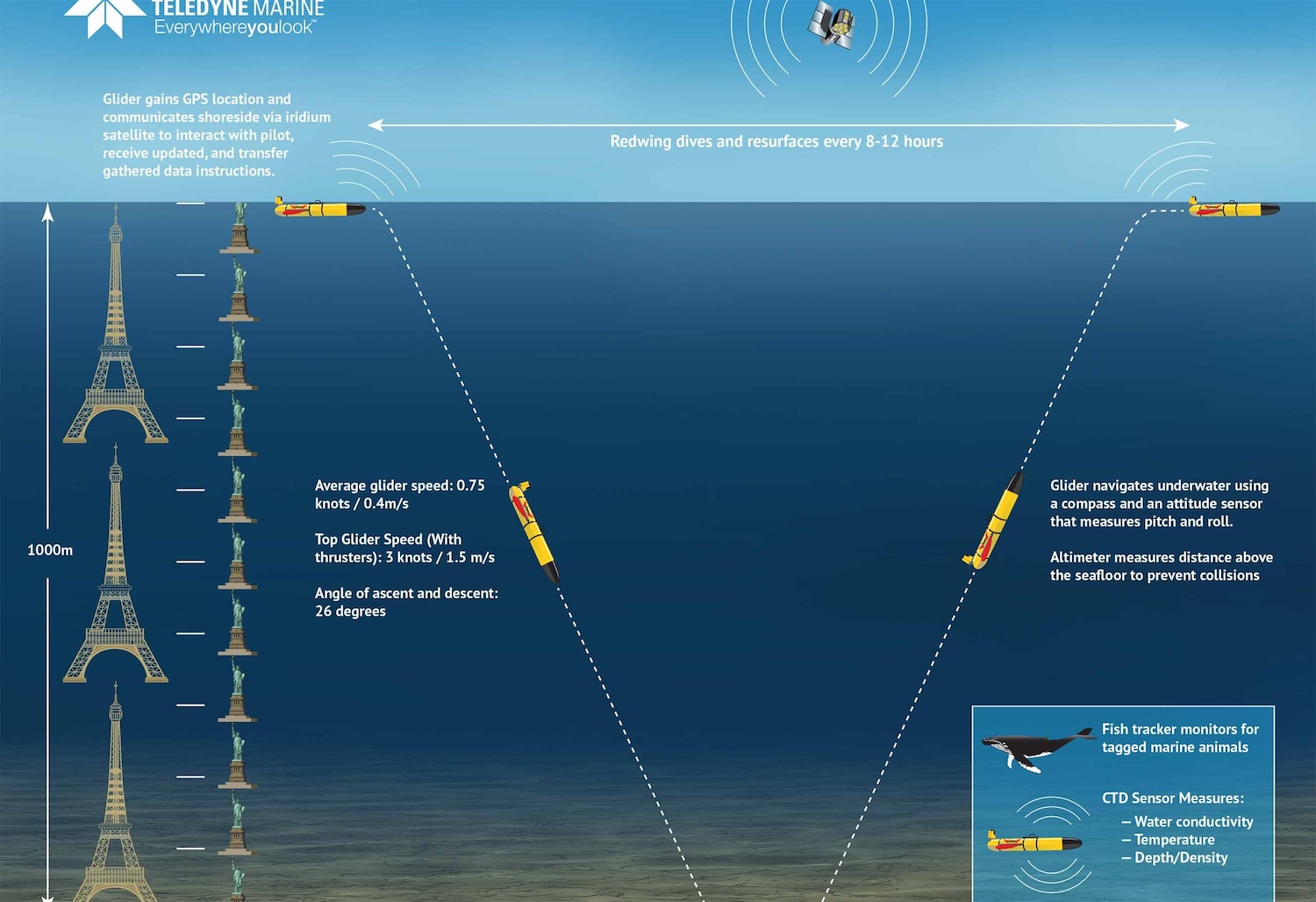
All that information can provide oceanographers with a three-dimensional glimpse of portions of the planet human eyes have never seen. The discoveries could also aid in meteorological efforts like monitoring ocean heat waves, hurricane intensity, and the health of marine ecosystems.
“We live on an ocean planet,” explained mission scientific co-lead Oscar Schofield. “All weather and climate are regulated by the ocean. This mission will give us another tool we need to achieve real understanding.”
It’s not only experienced scientists who are engaged with the project. Dozens of undergraduate students at Rutgers will assist by helping track Redwing’s journey, while writing blog updates about its many potential findings. Brian Maguire, Teledyne Marine’s chief operating officer, described Redwing as only the first of many such submersibles.
“It will pave the way for a future where a global fleet of autonomous underwater gliders continuously gather data from the oceans,” he said. “These will deliver early warnings of extreme weather and will track the impact of shifting ocean currents so that we can refine long-term climate projections in a way that scientists have dreamed of for decades.”

Shop Amazon’s Prime Day sale
