

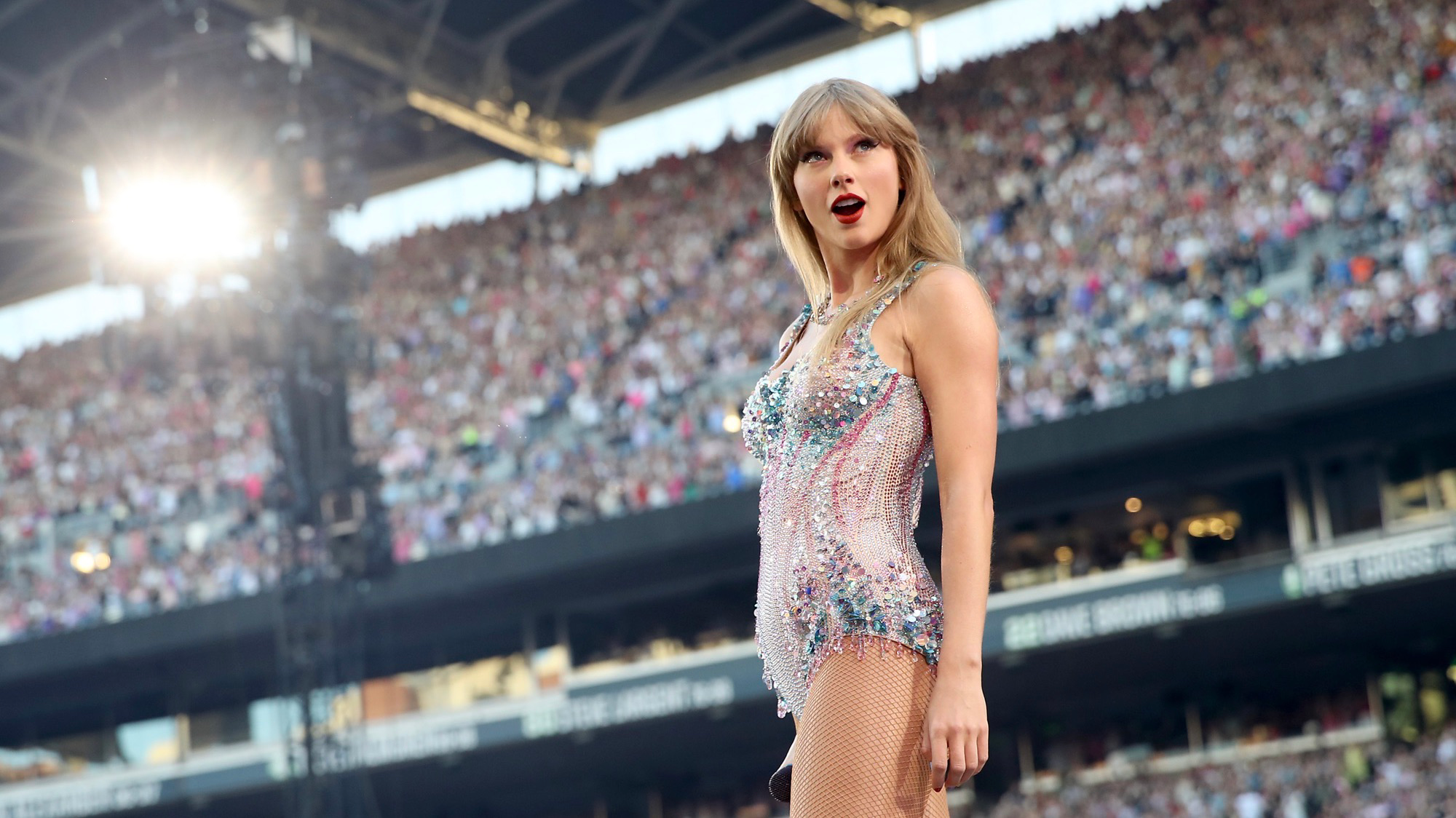
It’s a beautiful, clear night in July 2023 and over 70,000 people are packed into the open-air Lumen Field arena just south of downtown Seattle. They came decked in sparkles, glitter, and—naturally—handmade snake capes. Once inside, the lights go dark, a massive clock projection ticks, and then, Taylor Swift herself appears. Thousands jump, cry, and scream along to “Miss Americana & the Heartbreak Prince.” The surprising result of this revelry? A 2.3 magnitude earthquake: the world’s first-recorded SwiftQuake.
The Seattle SwiftQuake was the first, but certainly not the only time this happened. During Taylor Swift’s two-year, record-breaking Eras Tour, sold-out crowds caused plenty of seismic activity. But were these stomping Swifties really causing bonafide earthquakes?
A team of researchers from the Dublin Institute for Advanced Studies and Trinity College Dublin set out to investigate just that ahead of Swift’s sold-out, three-night run at Dublin’s Aviva Stadium. After the concert, they shared their results across social media and traditional news outlets in a coordinated effort to boost science education using Swift’s star power. Their findings have recently been published in the International Journal of Science Education reveal some surprising, seismic results.
Before ‘Sparks Fly’
Ahead of the concert, the team, led by Eleanor Dunn from the Dublin Institute for Advanced Studies, installed 42 seismometers across 21 different locations in shops and homes around the stadium. “Many residents were interested in the project’s outcome and were happy to have their home be used as a seismic station for a few weeks,” the authors wrote in the study.
Dunn also launched a new hashtag, #SwiftQuakeDublin, and logo for the project “to capture the curiosity of Swifties.” It seemed to really work, as people online and traditional media outlets began to catch wind of the project relatively quickly.
‘Are You Ready For It?’ The results
With the stage (and seismometers) set, Taylor Swift began her Dublin run on Friday, June 28, 2024. Despite a stage malfunction on Saturday night, the Dublin tour was most certainly a “beast that roared” as Swifties screamed along to some of the singer’s most popular tracks, from “Love Story” to “Blank Space.” Both Stevie Nicks and the singer’s now-fiancé Travis Kelce went to the Dublin concerts alongside 150,000 other Swifties, setting an attendance record for the stadium.
After the concert, the team collected and analyzed the data from each night. “The most significant increase in seismic displacement occurs towards the end of ‘Love Story,’” they wrote in the study.
Just ahead of the song’s final chorus, Swift sings, “He knelt to the ground and pulled out a ring and said…marry me Juliet you never have to be alone.” It was at that precise moment that the largest seismic activity was logged as the crowd all jumped in time to the beat of one of the singer’s most iconic songs.
However, the team’s “biggest surprise” came from when they looked at data collected by the Irish National Seismic Network (INSN). Established in 1962, the INSN uses 10 permanent seismometers to detect seismic activity in and around Ireland. When Swift performed “Shake It Off” each night, two different INSN stations, one outside of Dublin and another farther away in County Wexford, recorded seismic signals. This means that the vibrations from some 50,000 swifties all jumping to “Shake It Off” managed to travel over 62 miles away. That’s what some might call “Holy Ground.”
The ‘Afterglow’ of citizen science and education
In addition to the seismometer data, the team also encouraged concert goers to share their own videos, specifically from the stadium’s seating areas, to see what the crowd was doing at specific points during the show. In total, Swifties submitted 306 videos from across the three nights, helping boost engagement with the team’s work in a fun, tangible way.
Soon after the concert, the preliminary results were shared both on social media and with traditional media outlets in a press release. All in all, “SwiftQuakeDublin was discussed in three podcasts, 24 radio programmes, four TV programmes, 12 print news articles, and 53 web-based news articles, leading to an estimated 40,238,273 media impressions.” All that coverage helped people engage with the science, learning more about how seismic activity can be generated.
But did the seismic activity recorded during the Eras Tour actually qualify as an earthquake? Not in Dublin it seems. But the massive vibrations that traveled over 60 miles away, certainly isn’t something the authors or Swifties ought to shake off.
