

If you’ve ever struggled to squeeze a couch around a tight corner while moving into a new apartment, you’ll probably find that the pure mathematics problem known as the “sofa problem” is incredibly relatable.
The question seeks to find a maximum value for the area of a sofa that can slide around a 90-degree corner in a corridor of a given width. Mathematicians have long suspected that the answer lies with a shape called Gerver’s sofa. Now, a postdoctoral researcher in South Korea may have finally provided definitive proof that they were correct.
What is Gerver’s sofa?
While many sad-eyed movers have probably thought about this over the years, the question was first posed formally in 1966 by mathematician Leo Moser. In 1992, Joseph L. Gerver demonstrated the construction of a shape that has since come to be called Gerver’s sofa, saying that it provided the maximum possible area for a shape that can move around a corner. Mathematicians have long suspected he was correct, but no one was able to prove this conclusively.
Step forward mathematician Jineon Baek, whose epic 119-page paper on the problem was submitted to the arXiv pre-print server. The paper concludes that Gerver’s conjecture was correct: Gerver’s sofa, which has an area of 2.2195 units (assuming the corridor is one unit wide) is indeed the best we can do.
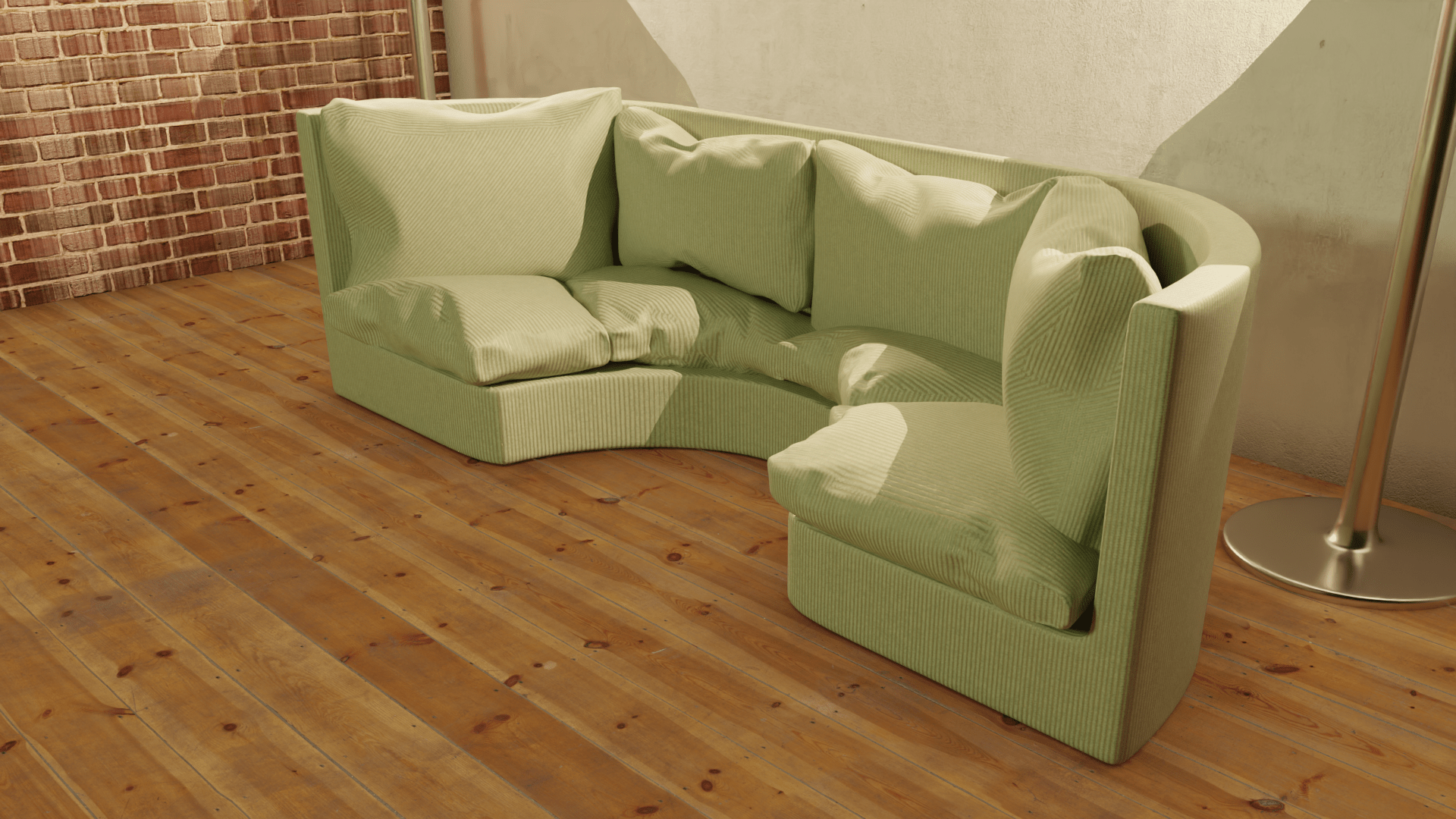
The first thing you’ll notice about Gerver’s sofa is that, well, it doesn’t look much like the one in your living room. Baek, a postdoctoral student at Yonsei University in South Korea, tells Popular Science that the term “sofa” here is more of a cute nickname for a “theoretical shape” that he describes as looking “like an old telephone.”
So why is Gerver’s sofa shaped like this? The simple answer is that the shape maximises its area, while still sliding continuously around a corner. The large cut-out in the middle allows it to pivot around the corner, and the curves on each opposite corner allow it to slide along the walls.
Baek explains that Gerver constructed the shape by assuming that the sofa must be touching the wall at all times. “The [points of contact between wall and sofa] make curves that trace out the boundary of the sofa,” he says.
Optimizing these curves—constructing them in a way that maximizes the shape’s area—yields Gerver’s sofa. The shape itself is actually extremely complex, which is part of the reason why the problem has proved so hard to crack over the years.
Apart from Gerver and Baek, other mathematicians have worked on this problem over the years, and the collective body of work had already established both the minimum and maximum possible areas of the sofa. The lower bound was established by Gerver himself, while the upper bound—2.37—was demonstrated in a 2017 paper by Yoav Kallus and Dan Romik.
In other words, mathematicians knew that the maximum area of the sofa lay somewhere between 2.2195 and 2.37 ,but not exactly where. Baek says his paper answers this question, proving that the lower bound is in fact as large as the sofa can get.
[ Related: Mathematician solves algebra’s oldest problem.]
The sofa proof
Baek explains that his proof has three steps. The first was confirming that the optimal shape for maximizing the area of the sofa was indeed the traditional telephone-like shape of Gerver’s sofa. The second was establishing exactly what that shape should look like. And the third involved establishing an upper bound on the area of that shape.
Step three was the trickiest, because it’s not simple to calculate the area of Gerver’s sofa. The nature of the shape means there’s no simple formula for determining its area
“The [shape of the] original sofa can change in an arbitrary way… it may consist of more than say, 100 different curves,” Baek explains. “And you cannot even control the number of different curves [needed]. So [its area] does not have a concrete formula.”
To work around this problem, Baek constructed another shape that was essentially a simplified version of Gerver’s sofa, showing that this shape must enclose all of the sofa. In other words, if you took a Gerver’s sofa of a certain length and width, it would always fit within a simplified sofa of the same dimensions.
Since the area of the simplified shape was straightforward to calculate, and it always enclosed the shape of the sofa, figuring out a way to optimize the simplified shape would put an upper bound on Gerver’s sofa.
Baek thus set out to find just how big the simplified shape could be, and its optimal shape. The answer turned out to be the same shape and size as Gerver’s sofa. This result means that the lower and upper bounds on the optimal sofa were the same, so Gerver’s sofa is the largest possible sofa that could fit around a corner.
“I used convex optimization and geometry to actually optimize [the simple shape’s area], and the optimum solution was Gerver’s sofa, completing the proof,” Baek says.
Sofa, so good
While the answer won’t necessarily help you to maneuver a plain old rectangular sofa around a tight corner, it does have potential real-world applications. Baek explains that the problem unites the fields of motion planning (the study of how to move objects from point to point in the most efficient way possible) and area optimization (a field of pure mathematics that studies how to maximize the area of a given shape).
Having said that, Baek does emphasize that like many problems studied in mathematical research, the sofa problem arose out of mathematicians’ curiosity and desire to extend their knowledge. “Like many pure math results, it is … likely that the result as-is won’t be used in real life.”
Still, Baek says that he’s seeking a new piece of furniture to celebrate solving this almost 60-year-old math problem.
“I still want a physical Gerver’s sofa at the corner of my office that I can actually sit on!”

More deals, reviews, and buying guides
